Lye for Soap Making: What to Buy, How to Store It and How to Mix It
Lye for soap making is pure sodium hydroxide. Here's which kind to buy, how to store it, how to mix it safely and how much a recipe needs.
On this page
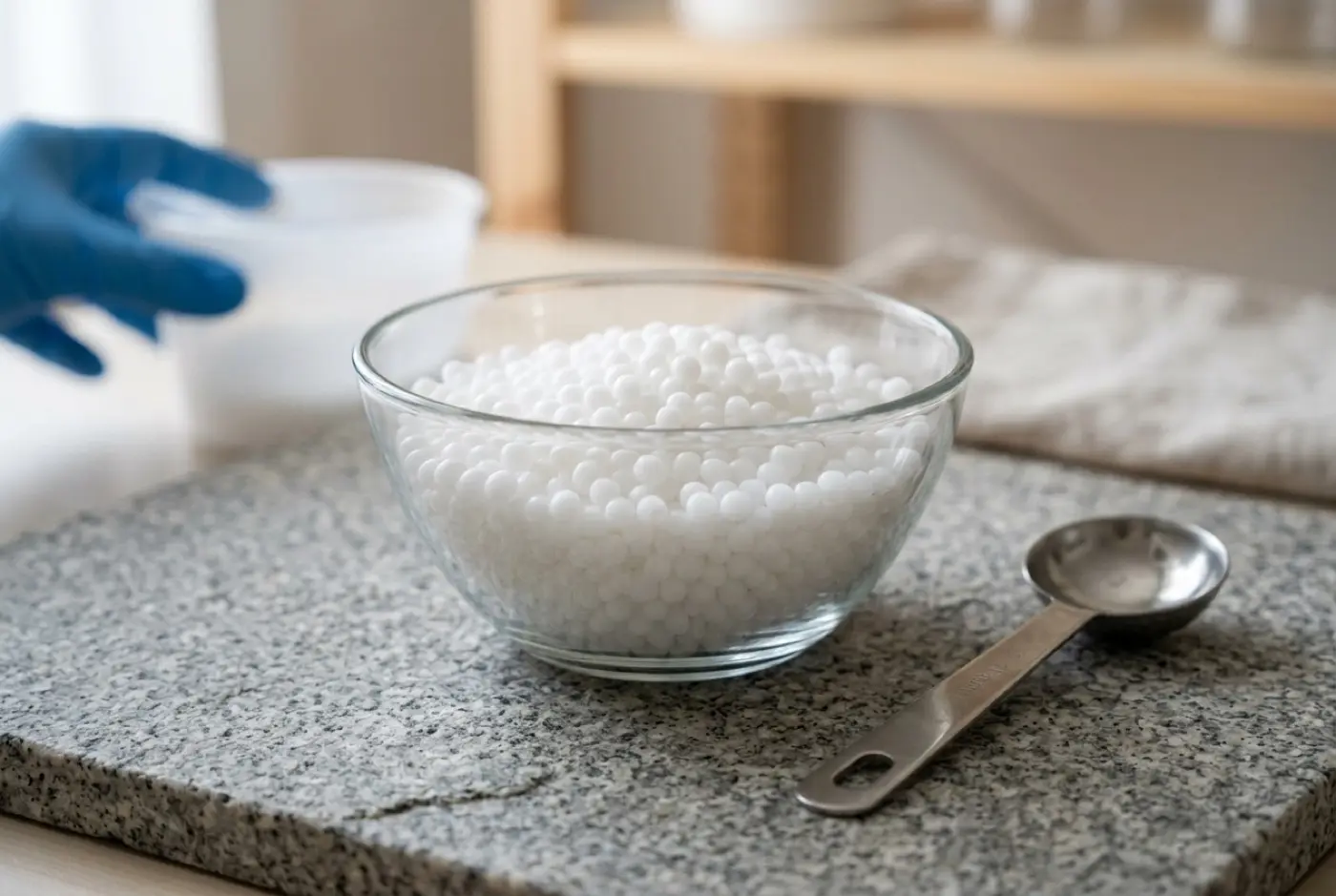
Lye for soap making is sodium hydroxide (NaOH): a white, odorless, strongly caustic solid that turns oils into soap. Buy it labeled 100% sodium hydroxide, with no other ingredients. You dissolve it in water to make a lye solution, mix that with oils, and the two react completely during saponification. No lye remains in a properly made bar. Liquid soap uses its cousin, potassium hydroxide (KOH).
The rest of this page covers what to buy, how to keep it, what actually happens when you mix it, and how to work out the amount.
What lye is, in plain English
“Lye” is an old word for any strong alkali leached from wood ash. Today soap makers mean one of two manufactured chemicals:
- Sodium hydroxide (NaOH) makes hard bar soap. This is what nearly every bar recipe on this site uses.
- Potassium hydroxide (KOH) makes soft or liquid soap. See sodium vs potassium hydroxide for when to use which.
Both are bases at the far end of the pH scale. That’s why they burn skin and eyes, and also why they can break fats apart. In soap, every gram of lye is consumed by the oils, which is why a cured bar is safe to wash with even though its raw ingredient was not.
Lye is not an additive you can leave out or swap for something gentler. Without it there is no reaction and no soap. The goal is not to avoid lye but to handle it carefully and use exactly the right amount.
How lye works in soap
Fats and oils are mostly triglycerides: three fatty acids attached to a glycerin backbone. Sodium hydroxide breaks those links. Each fatty acid pairs with sodium to become a soap molecule, and the glycerin is released and stays in the bar. That reaction is saponification.
Two things follow from that:
- Each oil needs a specific amount of lye. Coconut oil needs more lye per gram than olive oil. That number is the oil’s SAP value.
- Too much lye leaves a harsh, caustic bar; too little leaves a soft, greasy one. Soap makers deliberately use slightly too little. That gap is the superfat, and it’s your safety margin.
Buying lye: what the label should say
Lye is sold online by soap suppliers, in some hardware stores and by chemical suppliers. Buying from a soap supplier is the simplest route, because the product is meant for this use. Our guide to where to buy lye compares sources.
Before you buy
Beads, flakes and micro-pearls behave the same once dissolved. Micro-pearls pour cleanly and are easy to weigh; flakes can be dustier. Pick whichever your supplier stocks.
Some areas restrict sales or require you to be an adult to buy lye, because it’s also used in illegal drug production. Expect an age check or a quantity limit at some retailers.
Storing lye
Sodium hydroxide pulls moisture out of the air. Left open, it clumps, then hardens into a solid lump that’s hard to weigh accurately. It also reacts slowly with carbon dioxide in the air.
- Keep it in its original, tightly closed container, or in a sealed, clearly labeled #5 PP or HDPE plastic container.
- Store it high up or locked away, out of reach of children and pets, and away from food.
- Never put lye in a food or drink container, even temporarily. Lye looks a lot like sugar or salt.
- Write the purchase date on the lid.
- Close the container right after weighing; don’t leave it open while you set up.
If your lye has gone into one solid lump, replace it. Chipping at it is a splash and dust hazard, and you can’t be sure of its strength.
Mixing a lye solution, step by step
This is the moment most beginners worry about, and rightly. It’s also routine once you know what to expect.
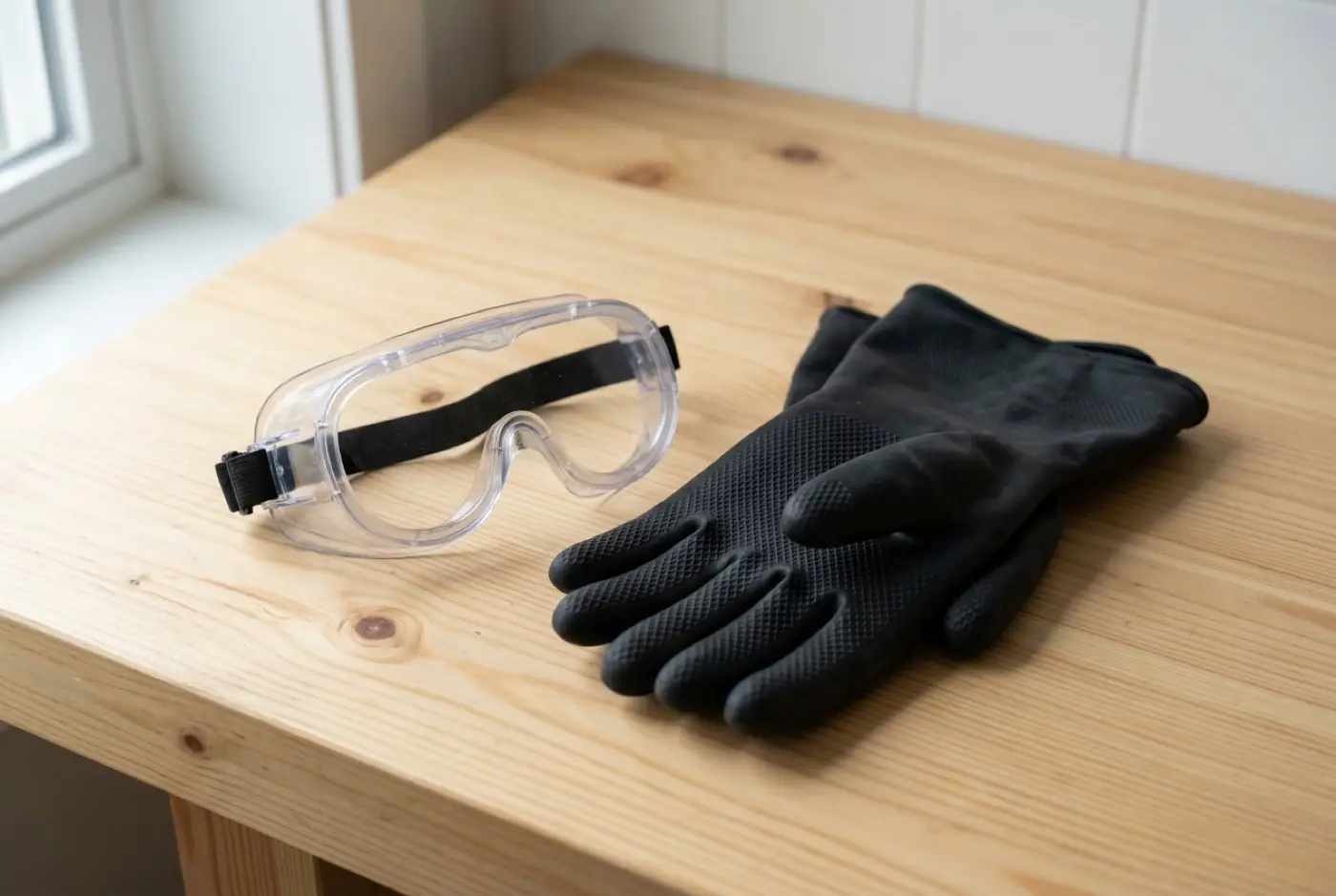
Set up first. Goggles and gloves on, long sleeves, kids and pets out of the room, window open or fan running. Have running water within reach. Use a heat-safe container made of #5 polypropylene (PP) plastic or stainless steel. Never aluminum: lye reacts with it, giving off hydrogen gas and heat. Avoid glass, which can weaken and crack over repeated use.
Weigh the water (distilled is best, because minerals in tap water can affect the soap) into your lye pitcher.
Weigh the lye into a separate, dry container.
Add the lye to the water, never the reverse. Pouring water onto a pile of lye can make it heat in one spot and erupt. Pour the lye in steadily and stir with a stainless or silicone utensil until it’s dissolved.
Expect the first minute. The solution heats up fast, often to near-boiling temperatures, and gives off fumes for roughly the first minute. Don’t lean over it; step back or let the fan carry the fumes away. The solution turns cloudy, then clears as the lye dissolves.
Let it cool. Set it somewhere stable where nobody will knock it over, labeled. Most cold process recipes mix when the lye solution has cooled to around 90–110°F (32–43°C), close to the temperature of the oils.
How much lye a recipe needs
The amount depends on which oils you use and how much of each, so there’s no single “lye per pound of oil” figure. The math is:
lye = Σ(oil weight × SAP value) × (1 − superfat)
A simple example: 1,000 g olive oil (a basic castile soap) at 5% superfat.
| Step | Calculation | Result |
|---|---|---|
| Lye to saponify all of it | 1,000 g × 0.135 | 135.0 g |
| Apply 5% superfat | 135.0 g × 0.95 | 128.3 g NaOH |
| Water at 33% lye concentration | 128.3 ÷ 0.33 − 128.3 | 260.4 g water |
Compare that to 1,000 g of coconut oil, which would need 183 g of lye before superfat. Swapping one oil for another without recalculating is how lye-heavy soap happens.
You don’t need to do this by hand. Enter your oils in the lye calculator and it handles the sums. Knowing the formula is still useful: it lets you sanity-check a recipe you found online. If you’d like a full walkthrough, see how to use a lye calculator.
Common mistakes
- Buying the wrong product. Drain cleaners with additives, or “lye” that’s actually a different chemical, can ruin a batch or worse. Read the label every time.
- Measuring by volume. A cup of beads and a cup of flakes weigh different amounts. Always weigh lye on a digital scale, in grams if you can.
- Using an aluminum pot or spoon. It corrodes, fizzes and releases hydrogen. Stick to #5 PP or stainless steel.
- Adding water to lye. Always lye into water.
- Leaving the pitcher unattended and unlabeled. A cooling lye solution looks like water.
- Treating a splash with vinegar. Rinse skin with running water for at least 15 minutes and remove contaminated clothing. For eyes, flush for at least 15 minutes and get medical help. Vinegar on a lye burn adds heat from a second reaction and delays the rinsing that actually helps. Our safety guide covers first aid in full.
- Recalculating nothing after a substitution. Any oil swap, even between two “similar” oils, needs a fresh run through the calculator.
Where to go next
Once you’re comfortable with the solution itself, the next pieces are how much water to use (water discount) and how to read your batter (trace). For a first project, castile soap uses a single oil, so the lye math is as simple as it gets.
FAQ
What kind of lye do I need for soap making?
For bar soap, 100% sodium hydroxide (NaOH), sold as beads, flakes or micro-pearls. For liquid soap, potassium hydroxide (KOH). The label should list nothing else.
Can I use drain cleaner as lye?
Only if the label says 100% sodium hydroxide with no other ingredients. Most drain cleaners contain metal flakes, dyes or other chemicals and are not safe for soap. Buy lye sold for soap making or labeled as pure sodium hydroxide.
Is there lye left in finished soap?
No, not in a correctly calculated and cured bar. The lye is consumed when it reacts with the oils, and the superfat leaves a margin of unreacted oil so none remains.
Can I make soap without lye?
Not from scratch. All true soap is made with lye. Melt and pour soap base was made with lye by someone else, so you skip handling it yourself.
How long does lye last?
Kept dry in a sealed container, it stays usable for years. Lye that has drawn in moisture and clumped into a solid lump should be replaced.
Comments
No comments yet. Made this recipe? Be the first to say how it went.