Sodium Hydroxide vs Potassium Hydroxide for Soap: NaOH or KOH?
Sodium hydroxide vs potassium hydroxide in soap: NaOH makes hard bars, KOH makes liquid and soft soap. How they differ and how to convert between them.
On this page
Sodium hydroxide (NaOH) makes hard bar soap; potassium hydroxide (KOH) makes soft and liquid soap. That’s the whole sodium hydroxide vs potassium hydroxide decision for most soap makers. The two aren’t interchangeable gram for gram: KOH is a heavier molecule, so you need about 1.4 times as much of it, and commercial KOH is usually only about 90% pure. Use the right lye for the product, and let the calculator handle the conversion.
Why one gives a bar and the other gives a liquid
Both chemicals do the same job: they split the fats in oil into fatty acids and glycerin, and the fatty acids become soap. What changes is the metal that ends up attached to each soap molecule.
- With sodium, you get sodium salts of fatty acids. These pack together into a firm, solid structure at room temperature. That’s a bar.
- With potassium, you get potassium salts. They’re far more soluble in water and don’t pack as tightly. The result is a soft paste that dissolves into a clear or slightly hazy liquid soap when you dilute it.
The oils matter too (coconut gives a harder sodium bar than olive does), but the lye is the bigger switch. No choice of oils will turn a 100% KOH soap into a firm bar.
Side-by-side comparison
| Sodium hydroxide (NaOH) | Potassium hydroxide (KOH) | |
|---|---|---|
| Common name | Lye, caustic soda | Potash lye, caustic potash |
| Makes | Hard bar soap | Liquid soap, soft soap, soap paste |
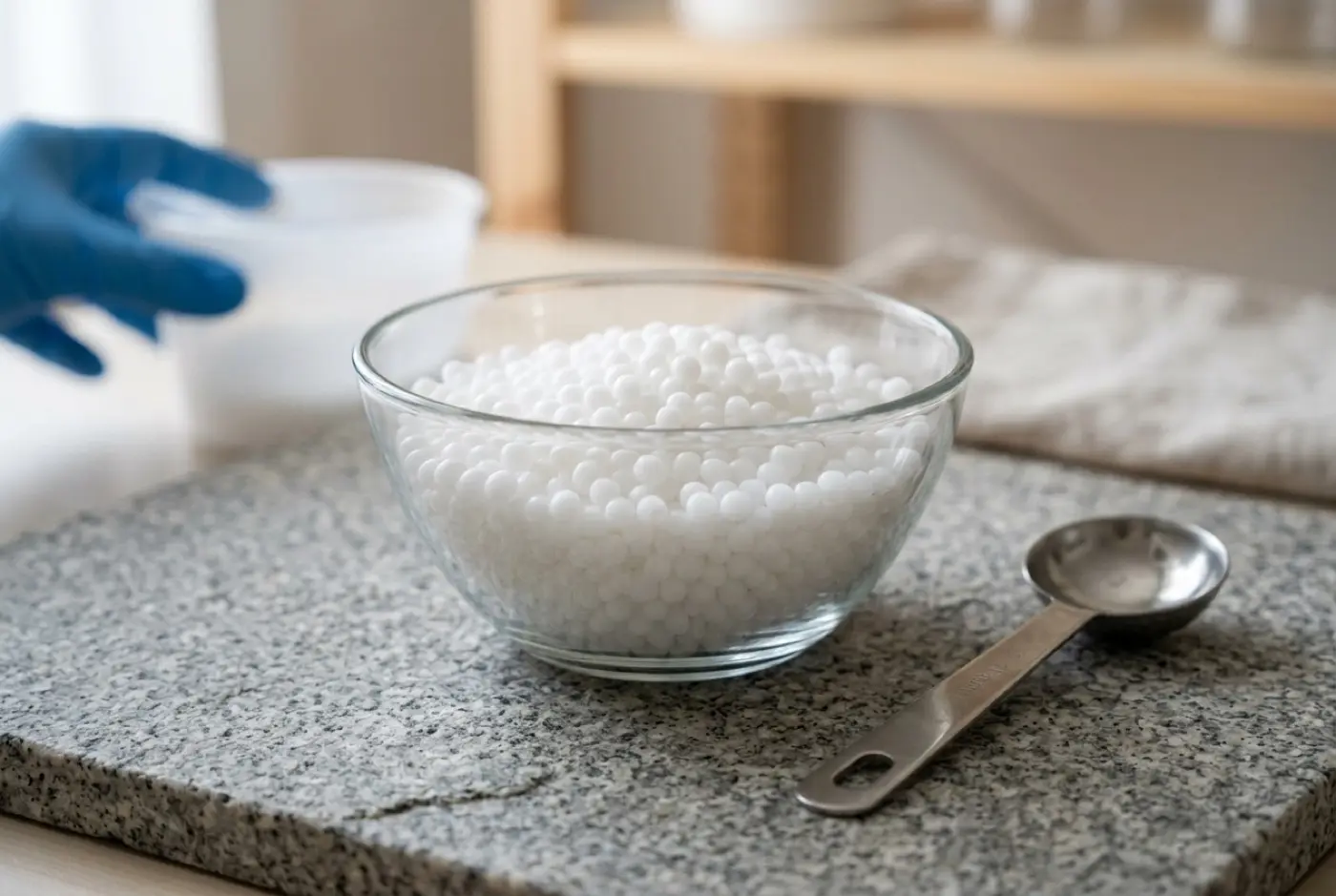
| Typical form | Beads, micro-pearls, flakes | Flakes |
| Typical purity sold to soap makers | About 99% or more | About 90% |
| Lye needed vs NaOH | 1× | About 1.403× (before purity adjustment) |
| Usual method | Cold process or hot process | Cooked as a paste, then diluted (liquid soap) |
| Typical superfat | 5% | 0–3%; excess oil can cloud liquid soap |
| Handling | Caustic: goggles, gloves, lye into water | Same precautions; also caustic and heats sharply when dissolved |
Neither is “gentler” in the bottle. Both are strong bases that burn skin and eyes, and the same rules apply: lye into water, never the reverse; #5 PP plastic or stainless steel, never aluminum; and running water for at least 15 minutes if it touches skin. See lye for soap making for mixing and storage.
The 1.403 conversion factor
Soap makers usually quote SAP values as grams of NaOH per gram of oil. To get KOH, multiply by the ratio of their molecular weights:
- KOH weighs about 56.1 g/mol.
- NaOH weighs about 40.0 g/mol.
- 56.1 ÷ 40.0 ≈ 1.403.
So olive oil’s NaOH SAP of 0.135 becomes 0.135 × 1.403 ≈ 0.189 for pure KOH. Coconut oil’s 0.183 becomes about 0.257.
That’s for pure KOH. The flakes you buy are typically around 90% potassium hydroxide, with the rest mostly water and some potassium carbonate. To deliver the same amount of actual KOH, you divide by 0.90. The site’s lye calculator does both steps when you switch it to KOH, using 1.403 ÷ 0.90 as its multiplier.
Worked example: converting a recipe
Here’s the full conversion for a simple liquid soap: 700 g olive oil and 300 g coconut oil, 1% superfat.
| Step | Calculation | Result |
|---|---|---|
| NaOH to saponify all oils | (700 × 0.135) + (300 × 0.183) = 94.5 + 54.9 | 149.4 g |
| Convert to pure KOH | 149.4 × 1.403 | 209.6 g |
| Apply 1% superfat | 209.6 × 0.99 | 207.5 g |
| Adjust for 90% purity | 207.5 ÷ 0.90 | 230.6 g KOH flakes |
If you’d skipped the purity step and weighed out 207.5 g of 90% flakes, you’d actually be adding only about 187 g of real KOH, roughly 10% short. In a liquid soap that leaves free oil that can cloud the finished soap or separate out.
Going the other way, from a KOH recipe back to NaOH, isn’t a simple reverse. A liquid soap formula usually has a low superfat and oils chosen for clarity, not bar hardness. Treat it as a new recipe and run it through the calculator.
Dual-lye soaps
Some soaps use both. Cream soaps and many shaving soaps blend NaOH and KOH so the bar or tub is softer, creamier and lathers more readily than a pure sodium bar. The split varies widely by maker and by product. If you try this, the calculator needs to know the proportion of each lye; don’t simply add a spoonful of KOH to a NaOH recipe.
Dual-lye work is an intermediate project. Get comfortable with plain bars and a plain liquid soap first. Our cream soap guide covers the method.
How the process differs
The lye choice changes the whole workflow, not just the number on the scale.
NaOH bar soap is usually made cold process: blend to trace, pour into a mold, let it set for a day or two, then cure for four to six weeks.
KOH liquid soap is usually cooked. You blend oils and KOH solution to a thick trace, then heat it until it becomes a translucent paste. The paste is then diluted with water, often in a ratio somewhere between equal parts and a few times its weight in water, depending on the oils and how thick you want the result. Liquid soap takes longer to come to trace and can seem to stall before it thickens. That’s normal.
Liquid soap is usually made with a lower superfat than bars, often 0–3%, because extra oil doesn’t bind into the clear liquid the way it hides inside a bar.
Buying and storing KOH
Potassium hydroxide is sold by soap suppliers and chemical suppliers, usually as flakes. Look for a label that says potassium hydroxide and gives a purity, often around 90%. As with NaOH, avoid products that list other ingredients. Our where to buy lye guide covers both.
KOH absorbs moisture from the air even more eagerly than NaOH, and flakes left open can turn damp and sticky. Store it in its original tightly sealed container, or a sealed, labeled #5 PP or HDPE container, away from children, pets and food. Close the container right after weighing.
When dissolved, KOH heats up sharply, like NaOH, and many makers find it can bubble or crackle as it goes in. Add it to the water slowly in a heat-safe container, and step back from the fumes.
Common mistakes
- Using NaOH for a liquid soap recipe. You’ll get a hard or gloppy soap that won’t dilute.
- Using the NaOH number with KOH. Without the 1.403 factor, the batch is about 30% short on lye and won’t saponify properly.
- Forgetting the purity adjustment. The calculator does it automatically; hand calculations often don’t.
- Storing them in look-alike containers. Label both clearly. They look similar and both absorb moisture from the air.
- Expecting a KOH soap to set in a mold. It won’t. Liquid soap is a paste-then-dilute process.
Where to go next
For bar soap, start with castile soap or the cold process guide. For liquid soap, the liquid soap method walks through cooking and diluting the paste, and liquid hand soap is a good first recipe.
FAQ
Can I use sodium hydroxide to make liquid soap?
Not true liquid soap. Sodium soaps are hard and won't stay dissolved at a usable concentration. Grating a sodium bar into water gives a gloopy, separating gel. Liquid soap needs potassium hydroxide.
Can I use potassium hydroxide to make bar soap?
Not on its own. A 100% KOH soap stays soft, like a paste. Small amounts of KOH are sometimes blended with NaOH in shaving and cream soaps for a softer, creamier bar.
How do I convert NaOH to KOH?
Multiply the NaOH amount (before purity adjustment) by about 1.403 to get pure KOH, then divide by the KOH purity, typically 0.90. A lye calculator does both steps when you choose KOH.
Why is potassium hydroxide only 90% pure?
Commercial KOH typically contains some water and potassium carbonate. Soap calculators assume about 90% purity and add lye to compensate.
Comments
No comments yet. Made this recipe? Be the first to say how it went.