Trace in Soap Making: How to Spot Light, Medium and Thick Trace
Trace in soap making is the point where oils and lye solution have emulsified and the batter thickens. How to recognize each stage and what to do at it.
On this page
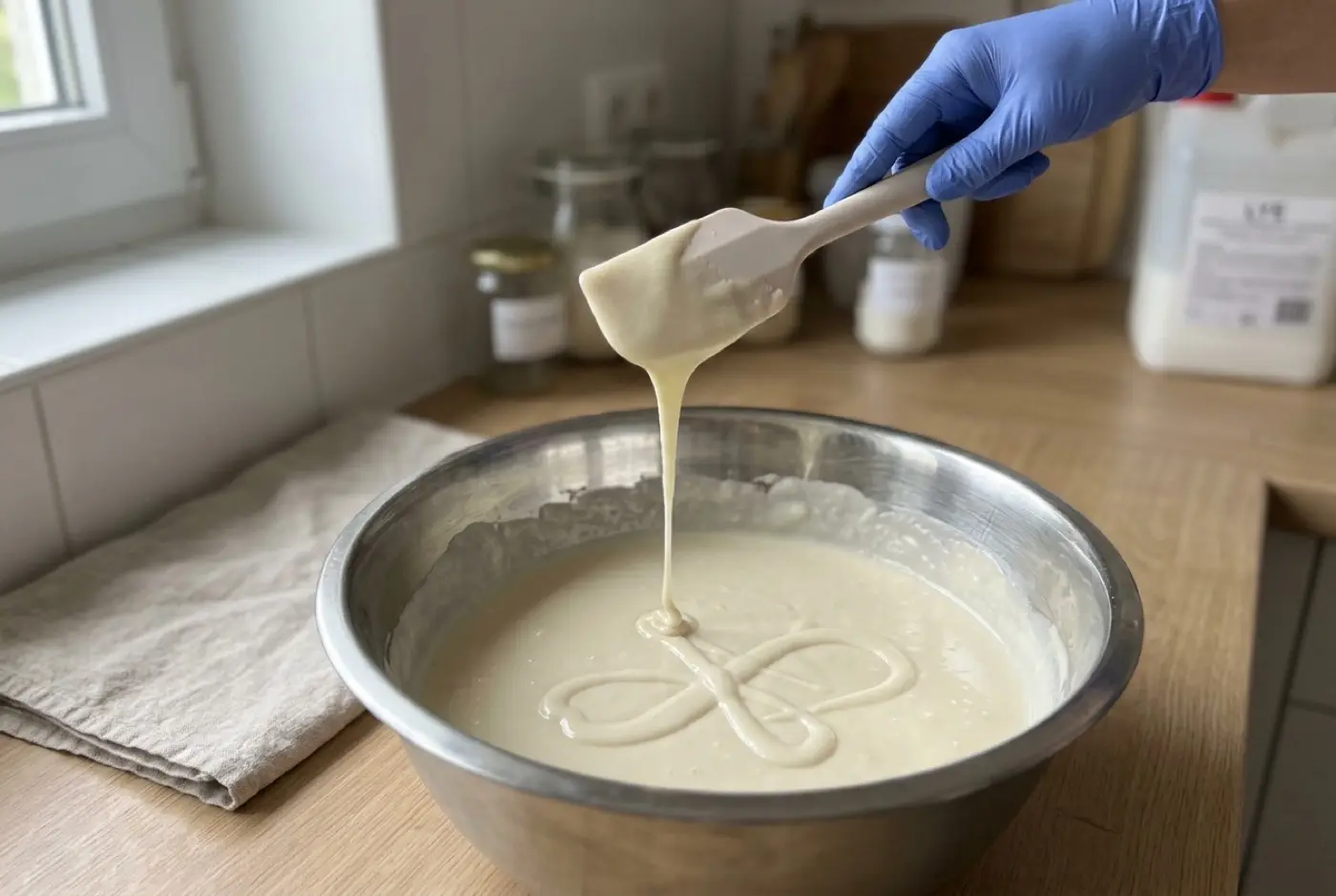
Trace is the point in soap making where the oils and lye solution have emulsified into a stable mixture that won’t separate. You’ll see it when the batter thickens enough that a drizzle from your stick blender leaves a faint trail, or “trace”, on the surface before sinking back in. Once you reach trace, the batter is ready to pour. How far past it you go (light, medium or thick trace) depends on the design you want.
What’s happening in the pot
When you first pour lye solution into oils, the two don’t mix. Water and oil separate, and the lye only reacts where they meet.
Stick blending breaks the lye solution into tiny droplets spread through the oil. Saponification starts at the surface of each droplet. The soap formed is itself an emulsifier, so as more forms, it holds the mixture together. Trace is the point where enough soap has formed to keep the batter emulsified on its own.
From there the reaction keeps going, and the batter keeps thickening. That’s why trace is a range of stages rather than one moment.
The stages of trace
| Stage | What it looks like | Drizzle test | Good for |
|---|---|---|---|
| Emulsion | Uniform color, no oily streaks, still very fluid | Drips vanish immediately | Not yet pourable; keep going a little |
| Light (thin) trace | Like thin custard or melted ice cream | Faint trail, disappears in seconds | Swirls, splitting colors, intricate designs |
| Medium trace | Like pudding or warm custard | Clear trail that holds for a while | Simple loaves, adding fragrance and additives, layers |
| Thick trace | Like thick pudding or frosting | Trails sit on top; batter can hold peaks | Textured tops, piping, rustic loaves |
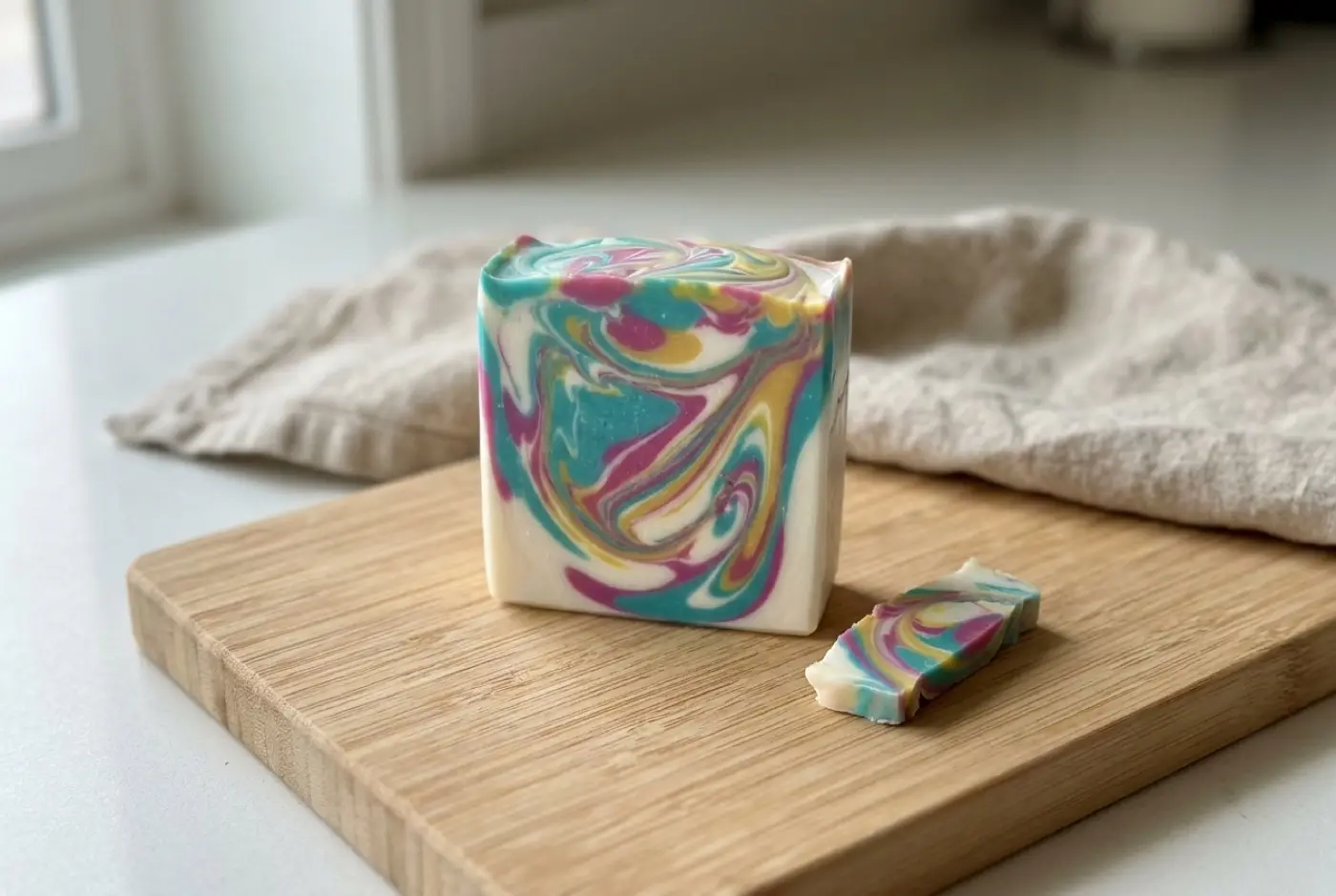
Most beginner recipes say to pour at light to medium trace. If you’re doing a swirl, stop early, because the batter will keep thickening while you split it and add colors.
How to reach trace
- Add lye solution to the oils, pouring down the shaft of the stick blender to avoid bubbles.
- Stir with the blender switched off to combine.
- Blend in short bursts of a few seconds, then stir by hand. Keep the head submerged to avoid splashing raw batter and pulling in air.
- Check after each burst. Recipes with lots of hard oils or fast fragrances can go from emulsion to medium trace in under a minute.
- Once you’re near your target, stop blending and stir by hand. Add fragrance, color and additives by hand.
Wear goggles and gloves throughout. Raw batter is caustic until it has saponified.
What speeds up or slows down trace
Understanding these factors lets you adjust a recipe’s working time on purpose instead of being surprised by it.
| Factor | Speeds up trace | Slows down trace |
|---|---|---|
| Temperature | Soaping warm, e.g. above about 120°F (49°C) | Soaping cool, around 80–100°F (27–38°C) |
| Oils | Hard oils and butters (coconut, shea, cocoa butter, tallow, lard), castor | High olive, sunflower, sweet almond and other liquid oils |
| Water | Water discount (higher lye concentration) | More water (lower concentration) |
| Blending | Long continuous stick blending | Short bursts, hand stirring |
| Fragrance | Many florals, spices and some vanilla-containing oils | Fragrances tested as “well behaved” in CP |
| Additives | Sugars, honey, milk, some clays | Most micas and oxides have little effect |
See water discount for the water side of this. If a fragrance accelerates hard, the batter can seize into a solid mass in the pot; see soap seized for what to do.
Stick blender vs hand stirring
You can reach trace by stirring with a spatula or whisk, which is how soap was made for centuries. It just takes a long time: tens of minutes for a fast recipe, and potentially much longer for a high-olive one. The stick blender is what makes modern cold process practical.
Hand stirring still has a place. Once you’re near light trace, switch to a spatula so the batter stops thickening while you work. Hand stirring is also how you incorporate fragrance, so you don’t accelerate a sensitive fragrance with the blender.
What hand stirring alone can’t easily do is guarantee a true emulsion. Batter that’s only been stirred is more likely to show false trace, below, or separate in the mold.
Reading trace in different recipes
Trace doesn’t look identical in every batter, so it helps to know what to expect:
- High-olive recipes like castile stay thin and glossy for a long time, then thicken gradually. Light trace can look almost like emulsion.
- Coconut-heavy recipes move quickly and go from light to thick within a minute or two of blending.
- Recipes with butters (shea, cocoa) can thicken fast as they cool. Make sure that’s trace and not the butter setting.
- Milk soaps often look thicker and more opaque early on, and the color can shift as the sugars warm up.
- Recipes with titanium dioxide or clay look more opaque from the start, so judge trace by the trail, not the color.
Whatever the recipe, the drizzle test is more reliable than how thick the batter looks in the pot.
False trace
False trace looks like trace but isn’t. It’s caused by hard oils and butters starting to solidify as the mixture cools, not by saponification. The batter thickens, you pour, and later the soap separates, with oily patches or a layer on top.
You’re likely to see it when:
- Your oils have cooled below the melting point of a butter or hard fat in the recipe.
- You soap at low temperatures with a recipe high in cocoa butter, shea, tallow or lard.
- You stir by hand rather than stick blending, so very little emulsifying has happened.
To avoid it, make sure all solid oils are fully melted and the batter is warm enough that they stay liquid, and use a stick blender. Our false trace and separation page covers fixing a batch that’s already separated.
Common mistakes
- Pouring at emulsion. The batter looks uniform but hasn’t traced. It can separate in the mold.
- Blending continuously. You overshoot to thick trace before you can add color or fragrance.
- Adding a fast fragrance at medium trace. Add it at emulsion or light trace if you’ve read it accelerates, and work quickly.
- Mistaking air bubbles for trace. A foamy surface from a blender head held too high can look thick. Tap the container and check again.
- Assuming a slow trace is a failed batch. High-olive recipes like castile soap can take many minutes even with a stick blender. Keep going in bursts.
Practice with a forgiving recipe
Castile soap traces slowly, which gives you time to watch every stage develop. A goat milk soap moves faster and is a good next step. When you’re ready to design, the soap swirl techniques guide shows which trace each swirl needs.
FAQ
What is trace in soap making?
The point where oils and lye solution have emulsified and won't separate. The batter thickens enough that drizzled soap leaves a faint trail on the surface before sinking back in.
How long does it take to reach trace?
With a stick blender, often a few minutes. It depends on oils, temperature, water amount and fragrance. Stirring by hand can take far longer.
Can I pour soap before trace?
No. Before trace the mixture isn't a stable emulsion and can separate in the mold, leaving oily layers or pockets of lye. Always reach at least light trace.
What if my soap won't trace?
Keep stick blending in short bursts with stirring in between. Slow recipes, especially high in olive oil, can take a while. If it truly never thickens, recheck your lye weighing and calculator inputs.
Comments
No comments yet. Made this recipe? Be the first to say how it went.