Saponification: The Chemistry of How Soap Is Made
Saponification is the reaction between oils and lye that makes soap and glycerin. What happens, how long it takes, and what it means at your workbench.
On this page
Saponification is the chemical reaction that turns fats and oils into soap. A strong alkali (lye: sodium hydroxide for bars, potassium hydroxide for liquid soap) breaks each fat molecule into three soap molecules and one glycerin molecule. The lye is used up in the process, which is why finished soap isn’t caustic. Every handmade bar, from a plain castile soap to a swirled loaf, is the product of this one reaction.
The reaction in plain English
Almost all of an oil or fat is made of triglycerides. Picture a capital E: the spine is a small molecule called glycerin, and the three arms are fatty acids, long chains of carbon and hydrogen.
When you add lye solution:
- The hydroxide in the lye attacks the joints where each fatty acid connects to the glycerin spine.
- Each fatty acid breaks free and pairs with a sodium (or potassium) ion. That pair is a soap molecule.
- The glycerin spine, now without its arms, floats free as glycerin.
Written as a word equation:
1 triglyceride + 3 sodium hydroxide → 3 soap molecules + 1 glycerin
That 3-to-1 ratio is why lye amounts are so precise. Each fat molecule needs exactly three units of hydroxide. Too little and some oil is left over; too much and some lye is left over.
What a soap molecule does
A soap molecule has two very different ends. The long fatty acid tail is attracted to oil and grease. The charged end, where the sodium sits, is attracted to water.
When you wash, the oily tails grab onto grease and dirt while the water-loving heads face outward. The grease gets surrounded and lifted into the rinse water. That’s all cleaning is, chemically. Different fatty acids give different tails, which is why coconut oil soap lathers big and cleans strongly, while olive oil soap is milder and slower to lather. The oils for soap making page covers what each oil contributes.
The named soaps
Each fatty acid gives its own soap, with its own name. A few you’ll see on ingredient lists and labels:
| Fatty acid | Rich in | Sodium soap (NaOH) | What it brings |
|---|---|---|---|
| Oleic | Olive, avocado, sweet almond | Sodium oleate | Mildness, conditioning feel |
| Lauric | Coconut, palm kernel | Sodium laurate | Big bubbles, strong cleansing, hardness |
| Stearic | Shea, cocoa butter, tallow | Sodium stearate | Hardness, stable creamy lather |
| Ricinoleic | Castor | Sodium ricinoleate | Lather boost, conditioning |
Labels sometimes list the finished soaps by their ingredient names instead: “sodium olivate” is saponified olive oil, “sodium cocoate” is saponified coconut oil. Both are describing the same thing as “saponified oils of olive and coconut”. See soap labeling requirements if you’re selling.
How much lye: SAP values
Because different oils have different fatty acid chains, a gram of each oil contains a different number of triglyceride molecules. Short-chain oils like coconut pack more molecules per gram, so they need more lye.
That amount is the saponification value, or SAP value. Coconut oil’s is about 0.183 g of NaOH per gram of oil; olive oil’s is about 0.135. A recipe’s total lye is just each oil’s weight times its SAP, added together, minus the superfat. The lye calculator does this for you.
Timeline: from pot to cured bar
Saponification isn’t instant and isn’t a single moment. Here’s how the chemistry lines up with what you see in cold process soap:
| When | What’s happening chemically | What you see |
|---|---|---|
| First seconds of blending | Lye and oil begin to react where they touch; the mix is an unstable emulsion | Thin, glossy, separates if you stop too early |
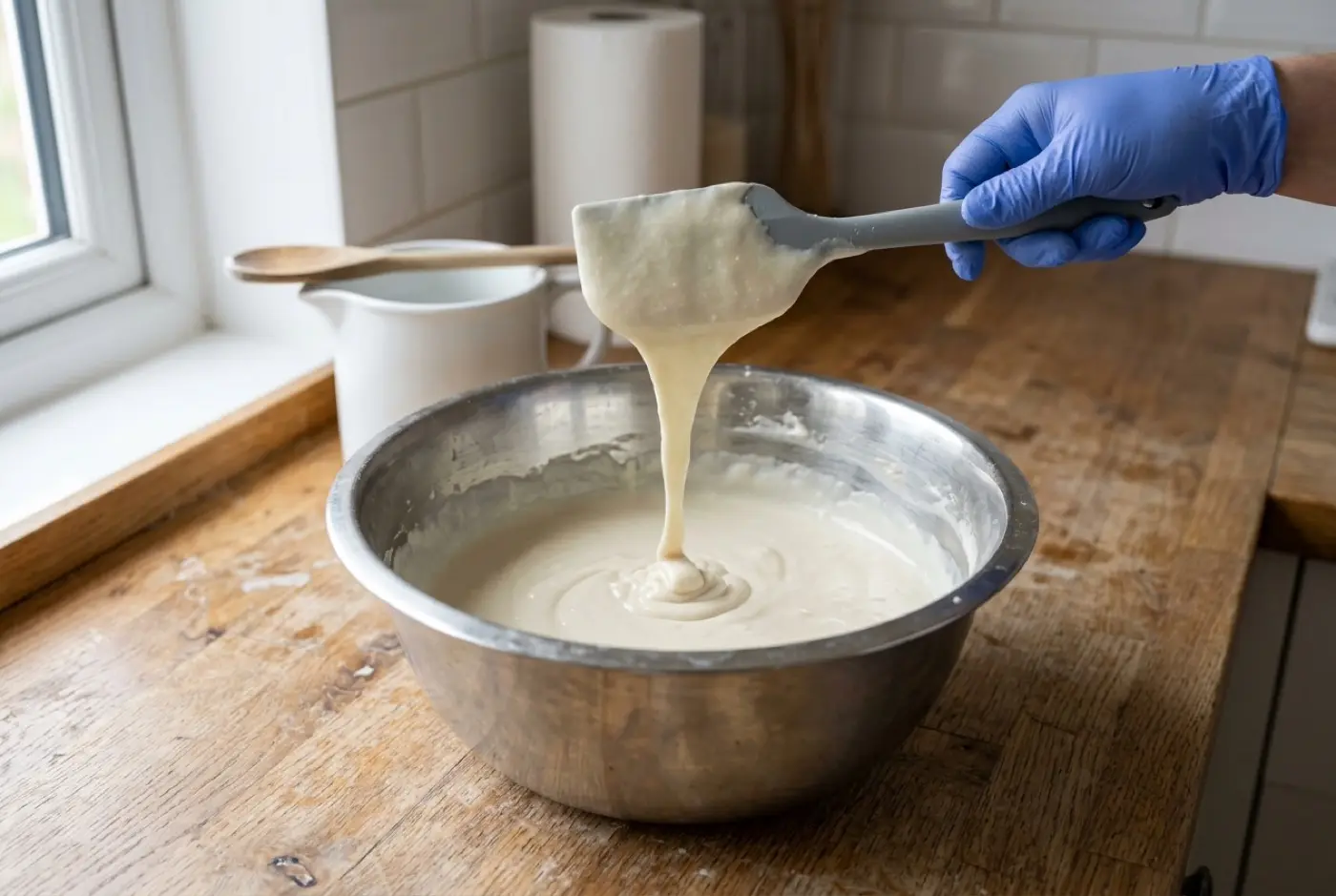
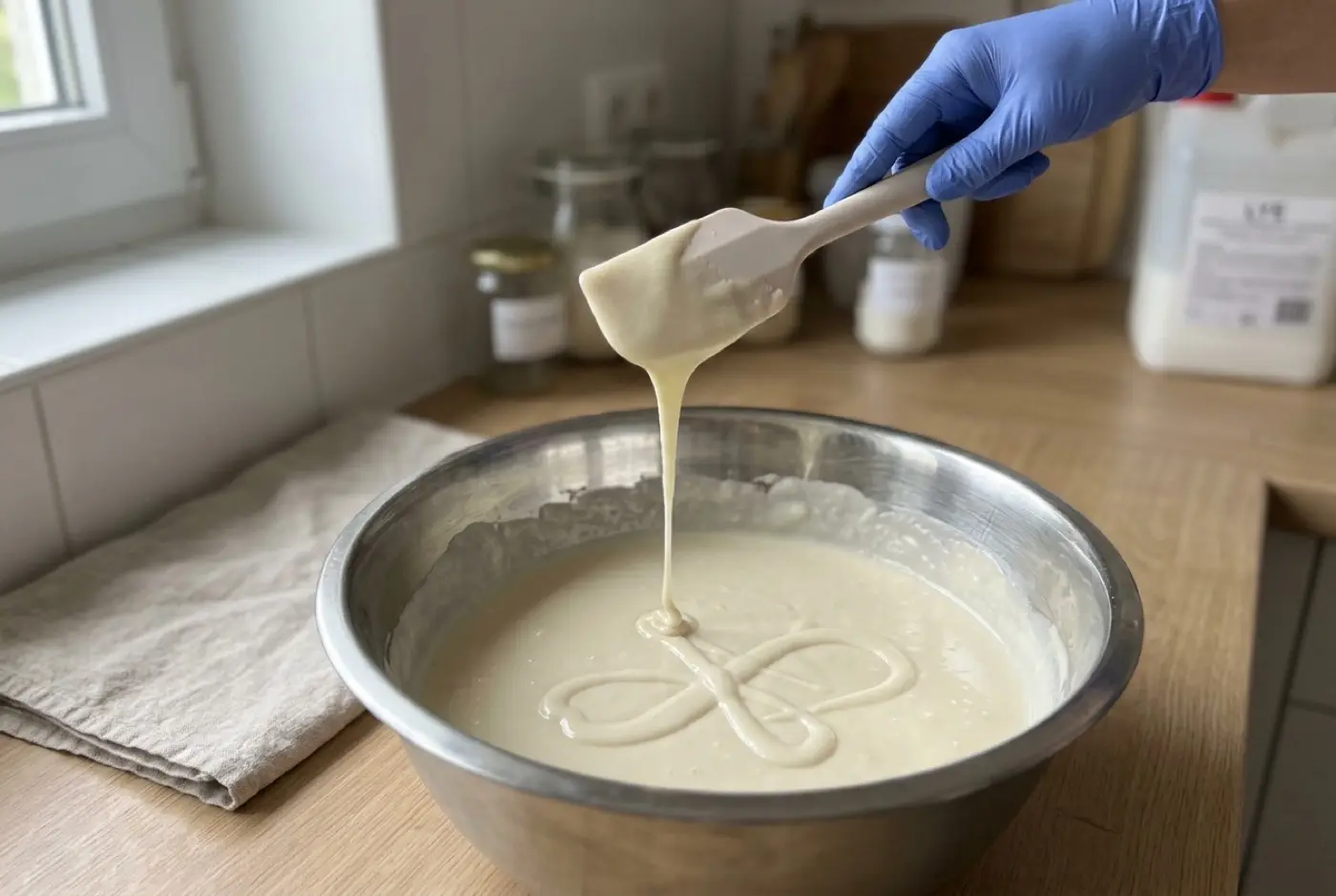
| Minutes in | Enough soap has formed to act as an emulsifier and hold the mix together | Trace: batter thickens and holds a trail |
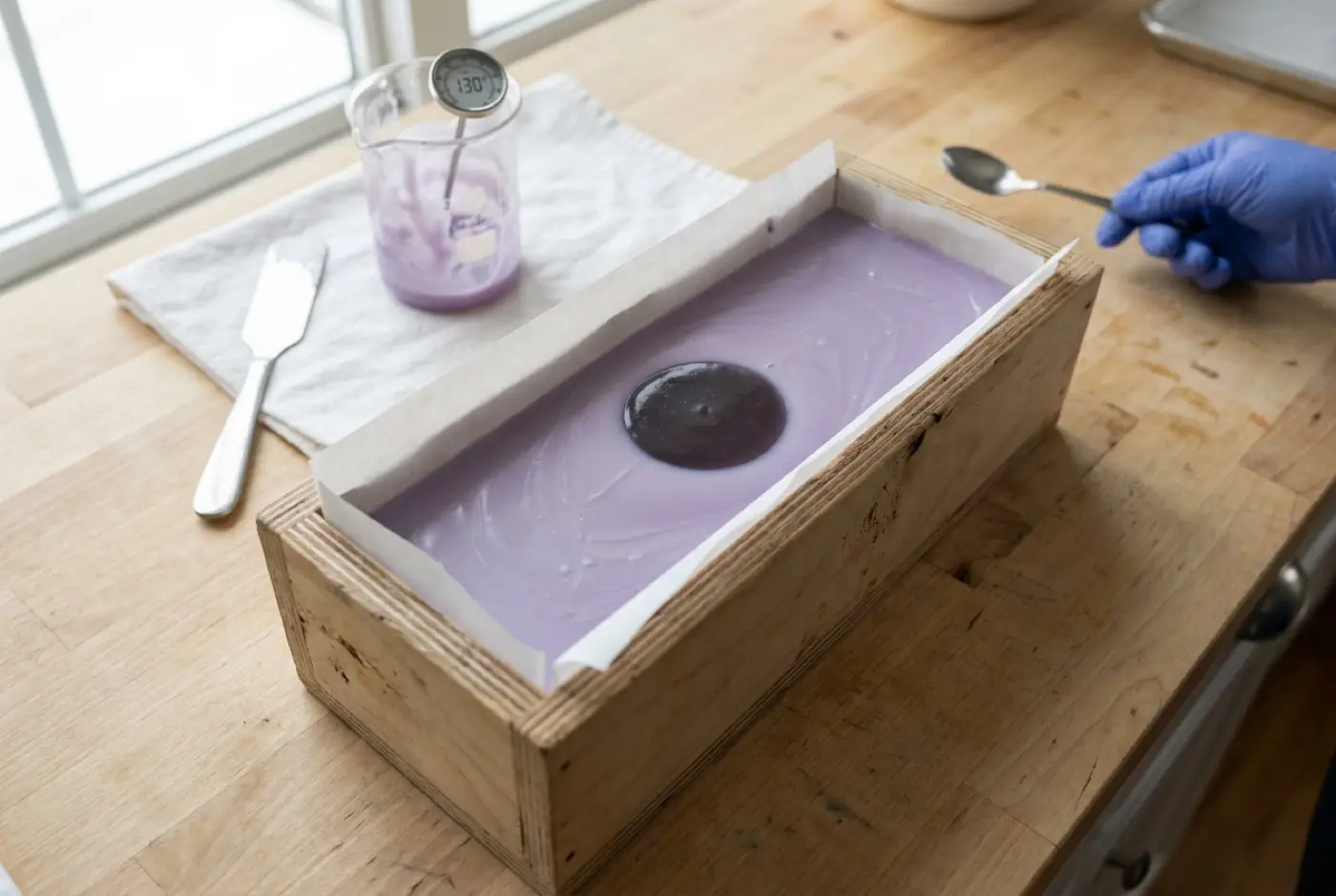
| First hours in the mold | Reaction speeds up as it generates its own heat | Batter warms; may go through gel phase |
| Roughly 24–48 hours | Most of the oil has saponified | Soap is firm enough to unmold and cut |
| Weeks 1–6 | Remaining reaction finishes; water evaporates; crystal structure settles | Bars harden, get milder, last longer in the shower |
The “24–48 hours” figure varies with the recipe, temperature and whether the soap gelled. Hot process pushes the reaction to completion during the cook, which is why hot process bars can be used sooner, though they still improve with drying time. The long cure is mostly about water loss and hardness, not about lye disappearing. See curing soap for the details.
Cold process, hot process and liquid soap
It’s the same reaction in every method. What changes is how fast you push it and when you stop handling the batter.
- Cold process lets the reaction finish on its own in the mold, using only the heat it makes. You pour at trace, while it’s still fluid, which is why you can do swirls and layers.
- Hot process adds heat after trace, usually in a slow cooker, to drive the reaction to completion before molding. The batter goes through stages that look like mashed potatoes and translucent gel, and is spooned rather than poured. See hot process soap.
- Liquid soap uses potassium hydroxide and is cooked to a paste, then diluted with water. Because potassium soaps dissolve readily, the result stays liquid. See liquid soap.
- Melt and pour base has already been saponified at a factory. Melting it doesn’t involve the reaction at all, which is why you don’t handle lye.
Where the glycerin goes
Glycerin is a by-product in industrial soap making, where it’s often separated out and sold. In handmade soap it stays in the bar. Glycerin draws moisture from the air, which contributes to the softer feel of handmade soap compared with many commercial bars. It’s also why handmade bars can “sweat” beads of moisture in humid conditions; see sweating soap.
Heat: the reaction makes its own
Saponification gives off heat. In a loaf mold that heat builds up, because the soap in the middle is insulated by the soap around it. That’s why the center of a loaf can get noticeably hot, and why some loaves go translucent in the middle (gel phase) while the edges don’t.
You can use that heat. Insulating the mold encourages full gel; chilling it slows the reaction and prevents gel. Milk, honey and sugar add their own heat and can push a loaf toward overheating, so recipes with them are often kept cool.
Common mistakes and misconceptions
- “Natural soap has no lye.” All true soap is made with lye. In a properly made bar, the lye has been consumed by the reaction.
- “Cure time is when the lye goes away.” Most saponification is done within a day or two. Cure is mainly drying and hardening.
- Expecting soap to be pH neutral. Properly made soap is naturally alkaline, typically somewhere around pH 9–10. A reading in that range doesn’t mean there’s free lye. The surest protection is a recipe you’ve run through the calculator, weighed carefully. If you suspect a problem, see lye-heavy soap.
- Adding oil after trace without recalculating. Oil added at trace still reacts with whatever lye is left, so it belongs in the calculator.
- Treating saponification as all or nothing. Free oil (superfat) and a fully saponified soap coexist in every bar; that’s by design.
See it in a recipe
The clearest demonstration is a single-oil soap: castile soap is 100% olive oil, so every soap molecule in it is an olive soap. Compare it with a 100% coconut oil soap to see how much the fatty acids change hardness and lather. The cold process guide walks through the full process.
FAQ
What is saponification in simple terms?
It's the chemical reaction in which lye breaks oils and fats into soap and glycerin. Without it, oil and lye solution are just two caustic, greasy liquids.
How long does saponification take?
In cold process soap, most of it happens in the first 24–48 hours. Hot process speeds it up so it's essentially complete when the cook is done. The four to six week cure that follows is mostly water evaporating.
Is saponified soap still lye?
No. Once saponified, the lye has become part of the soap molecules. That's why ingredient lists sometimes say "saponified olive oil" rather than "olive oil and sodium hydroxide".
Does saponification produce glycerin?
Yes. Every fat molecule that reacts releases one glycerin molecule. Handmade soap keeps that glycerin in the bar.
Comments
No comments yet. Made this recipe? Be the first to say how it went.