False Trace and Separation in Soap: How to Spot and Fix It
False trace is batter that thickens because hard oils are solidifying, not because it has emulsified. Poured that way, it can separate into oil and caustic liquid in the mold.
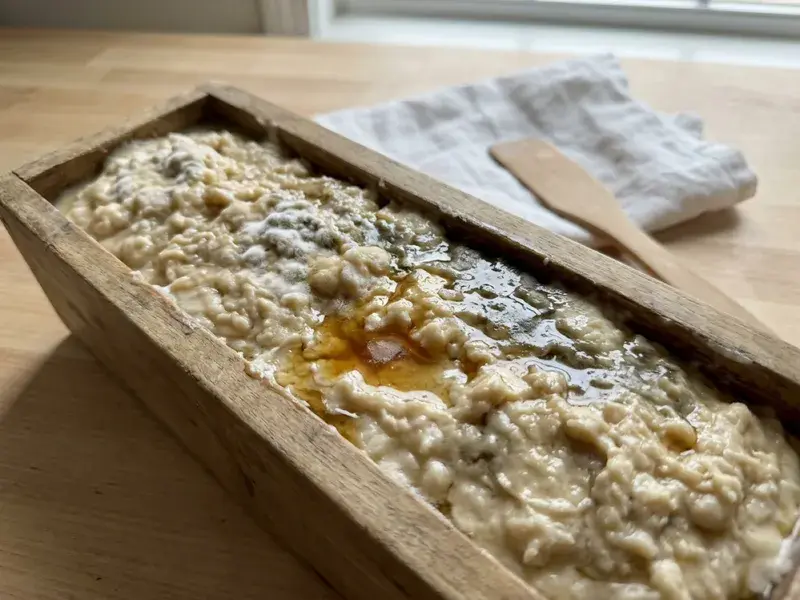
Is it safe to use?
If the batter recombined and set evenly, it's usually fine after cure. A batch that set with pools of oil or liquid isn't safe as is, because that liquid can be lye. Recombine it with hot process or discard it.
Wet pockets inside cut bars? Lye pockets
Causes, ranked by likelihood
- Most likely
Hard oils cooled and set
Below roughly 90°F (32°C), butters and stearic-rich oils start to solidify. The batter thickens like trace but hasn't emulsified.
- Common
Not enough mixing
Hand stirring, or a few seconds of stick blending, can leave batter that looks thick but hasn't emulsified. Lye solution and oils drift apart once poured.
- Sometimes
An additive or fragrance broke the emulsion
Some fragrances, and additives such as large amounts of clay or purees, can cause separation in the pot or later in the mold, especially when the soap overheats.
Fix this batch
Re-emulsify or cook it
- Before pouring: gently warm the batter to about 100–110°F (38–43°C) and stick blend again. If it was false trace, it will thin out, then come to a real trace.
- Separated in the mold within the first few hours: wearing gloves and goggles, scrape everything back into a pot and stick blend until smooth.
- Then cook it on low heat as hot process until it looks like petroleum jelly, and mold it.
- Already set with pools of liquid or oil: don't use it. Rebatch only if you have accurate weights, otherwise discard.
Prevent it next time
Warm enough, mixed enough
- Keep oils and lye in the 90–110°F (32–43°C) range, warmer for recipes high in butters.
- Stick blend in 5–10 second bursts with stirring between, and test for real trace before pouring.
- Add fragrance to the oils before the lye so it's dispersed early.
- Keep heavy additives within the amount the recipe calls for.
The warm-up test
Unsure whether you have false trace? Set the pot in a warm water bath for a few minutes, or warm it very gently on low heat, then stir.
- False trace loosens and turns thin again as the butters melt. That’s your cue to stick blend to a real trace.
- Real trace may loosen slightly but stays smooth and uniform. Warmth won’t undo emulsification.
The test takes a few minutes and costs nothing. Pouring false trace can cost the whole batch. More on what trace is in our trace guide.
The science behind it
FAQ
What does real trace look like?
Drizzle batter from the blender onto the surface. At real trace, it leaves a line that sits on top for a moment before sinking. The batter is smooth and uniform, like thin custard.
Why is there oil on top of my soap?
Either the batter separated because it wasn't emulsified, or the recipe has a very high superfat or too little lye. Check your weights, and treat any liquid as possibly caustic.
Can a separated batch be saved?
Often, if you catch it within a few hours. Recombine and hot process it. Once it has fully set with liquid pockets, saving it is harder.
Is stick blending too long bad?
It can thicken batter too fast for designs, but it won't cause false trace. Under-mixing is the bigger risk.
Comments
No comments yet. Made this recipe? Be the first to say how it went.