Essential Oils for Soap Making: Usage Rates, Blends and What to Avoid
Essential oils for soap making are usually used at 1–5% of total oil weight, depending on the oil. Here's how to calculate the amount, which oils behave, and which to keep low.
On this page
Essential oils for soap making are plant-derived aromatic oils used to scent bars, usually at about 1–5% of total oil weight, with each oil carrying its own limit. Lavender, peppermint, eucalyptus, cedarwood and folded orange are reliable starting points. A few, like clove and cinnamon bark, are best kept very low or skipped.
That percentage is the key idea on this page. It’s based on the weight of the soaping oils (not the lye, not the water, not the whole batch) and it applies to rinse-off bar soap. Leave-on products like lotion use much lower rates, so don’t borrow numbers across.
How essential oils behave in soap
Unlike fragrance oils, which are blended to survive soap, essential oils are whatever the plant produced. That has a few practical consequences.
They’re volatile. The lightest molecules, the “top notes,” evaporate fastest. Single-fold citrus oils can smell bright in the pot and almost vanish by the end of cure. Heavier oils like patchouli, cedarwood and vetiver hang on.
Lye changes some of them. The batter is strongly alkaline, and a few aroma compounds don’t survive it well. The scent you get from a cured bar is often softer and a little different from the bottle.
Some speed up trace. Certain floral and spice oils are known among soapers to make batter thicken faster. Clove and lemongrass are often mentioned. How much acceleration you see depends on the rest of the recipe and your temperatures, so test new oils in a small batch first.
Some affect color. Oils with a strong natural color, or ones that react with the batter, can tint or darken a bar. Clove is a common example of an oil that can discolor.
Usage rates for common essential oils
These rows match our essential oil usage chart, which you can bookmark and print. All figures are a percentage of total oil weight in rinse-off cold process soap.
| Essential oil | Typical rate | Upper end we use | Behavior and notes |
|---|---|---|---|
| Lavender | 3–5% | 5% | Behaves well at trace. Good alone; softens citrus. |
| Peppermint | 1–3% | 3% | Can feel tingly at higher rates. Pairs with eucalyptus or rosemary. |
| Eucalyptus | 2–4% | 4% | Pairs with peppermint and lemon. |
| Tea tree | 2–3% | 3% | Strong, medicinal scent; lavender rounds it out. |
| Lemongrass | 1–3% | 3% | Can accelerate trace. Helps hold citrus blends. |
| Sweet orange (10-fold) | 3–5% | 5% | Single-fold fades fast; use 5- or 10-fold. Needs an anchor. |
| Rosemary | 1–3% | 3% | Herbal; pairs with peppermint and lavender. |
| Patchouli | 1–2% | 2% | A little goes a long way. Anchors almost anything. |
| Cedarwood (Atlas) | 2–4% | 4% | Woody base note; anchors citrus and lavender. |
| Clove bud | 0.5–1% | 1% | Accelerates trace and can discolor. Small amounts in spice blends. |
These are placeholder working ranges for the launch edition and are being checked against current IFRA guidance. Your supplier’s documentation always wins.
How to calculate the amount in grams
The math is one multiplication:
Essential oil (g) = total oil weight (g) × usage rate (%) ÷ 100
Worked example, a 1000 g batch scented with a lavender and cedarwood blend at a combined 4%:
| Step | Calculation | Result |
|---|---|---|
| Total scent allowance | 1000 g × 4% | 40 g |
| Lavender (3%) | 1000 g × 3% | 30 g |
| Cedarwood (1%) | 1000 g × 1% | 10 g |
Each oil in a blend still has to stay under its own limit. In the example, lavender at 3% and cedarwood at 1% are both well inside their ranges. If you blend three or four oils, check each one individually, not just the total.
The fragrance calculator does this for you one oil at a time: enter your oil weight, pick the essential oil and its rate, and it shows the grams and warns you if the rate is above the chart’s upper end. Run it once per oil in a blend.
Oils to keep low or avoid
Some essential oils have low skin-safety limits even in wash-off products, or cause problems in the pot. Treat these with caution:
- Cinnamon bark and cassia. Commonly avoided in soap altogether because of their very low limits. If you want a cinnamon note, look for a fragrance oil formulated for soap.
- Clove (bud or leaf). Keep to about 0.5–1%, used as an accent in spice blends. It can speed trace and darken the bar.
- Oils sold as “fragrance” or “nature identical.” These may be fragrance oils, not essential oils. Read the listing and SDS so you know which limits apply.
If a supplier doesn’t provide an SDS for an essential oil, buy from one that does. For the cost and safety tradeoffs between the two scent types, see fragrance oils vs essential oils.
Blending so the scent lasts
Single essential oils can smell flat after cure, especially citrus. A simple three-part structure helps:
- Base note (holds the blend): patchouli, cedarwood, vetiver. Small share, often a quarter or less of the blend.
- Middle note (the body): lavender, rosemary, eucalyptus, lemongrass.
- Top note (the first impression): orange, peppermint, other citrus.
A few combinations that work well in soap:
- Orange and patchouli. Folded orange as the main note with a little patchouli to anchor. Classic for a reason.
- Lavender and cedarwood. Calm, woody and very stable through cure.
- Peppermint, eucalyptus and rosemary. Bright and herbal. Keep peppermint toward the lower end of its range if the bar is for sensitive faces.
- Lemongrass and lavender. Lemongrass gives the citrus feel without the fading of orange.
Some makers add a teaspoon or so of kaolin clay per 500 g of oils and stir the essential oil into it first, finding that it helps the scent hold. Results vary, so try it side by side with a plain batch before relying on it.
Adding essential oils to cold process soap
- Weigh the essential oil in advance into a small glass container. Measure by weight, not drops; drops vary too much.
- Decide when to add. For well-behaved oils like lavender, stir in at light trace. For oils known to accelerate (spice, some florals), you can stir them into the room-temperature oils before adding lye, which gives you more working time.
- Soap at moderate temperatures. Around 90–110°F (32–43°C) gives more control than hot oils, especially with accelerating scents.
- Stir by hand first, then pulse briefly with the stick blender only if needed. Over-blending after scent goes in is a common cause of thick batter.
- Pour promptly if the batter starts to thicken, and plan simple designs for unfamiliar oils.
Keep your goggles and gloves on through this whole stage. Raw batter with essential oil in it is still caustic.
Common mistakes
- Measuring by volume or drops. Essential oils differ in density, so a teaspoon of one oil isn’t the same weight as another. Always weigh.
- Calculating from the whole batch weight. The percentage is of the oils only. Including water and lye inflates the amount.
- Assuming “natural” means “gentle at any amount.” Essential oils have real limits. More isn’t better past the oil’s maximum.
- Using single-fold orange in a long-cure bar. By the time a castile is ready, it may smell of nothing. Use folded citrus or anchor it.
- Making a full batch with an untested oil. Try a 500 g test batch first to see how it behaves at trace and after cure.
- Storing oils warm and open. Essential oils oxidize and change scent with age, heat and air. Keep bottles capped, cool and dark.
Recipes that use essential oils
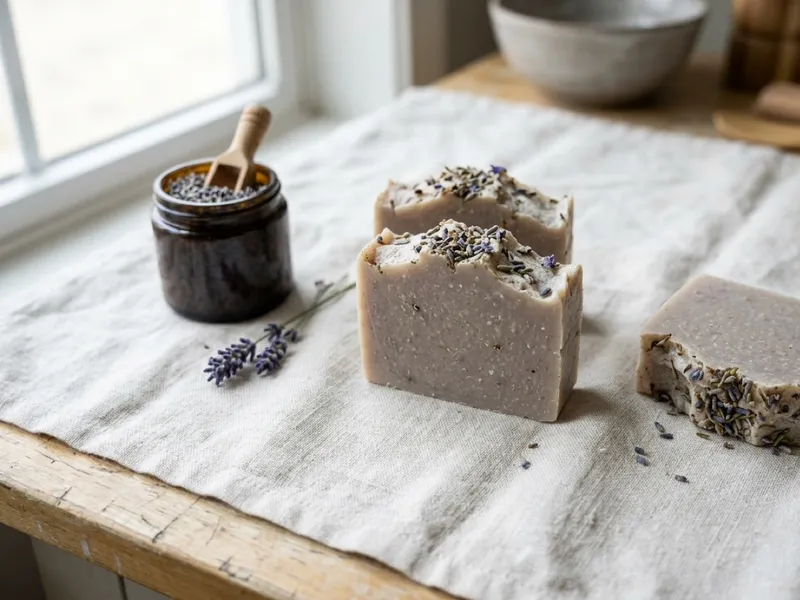
- Lavender soap: a single-oil bar and the easiest place to start.
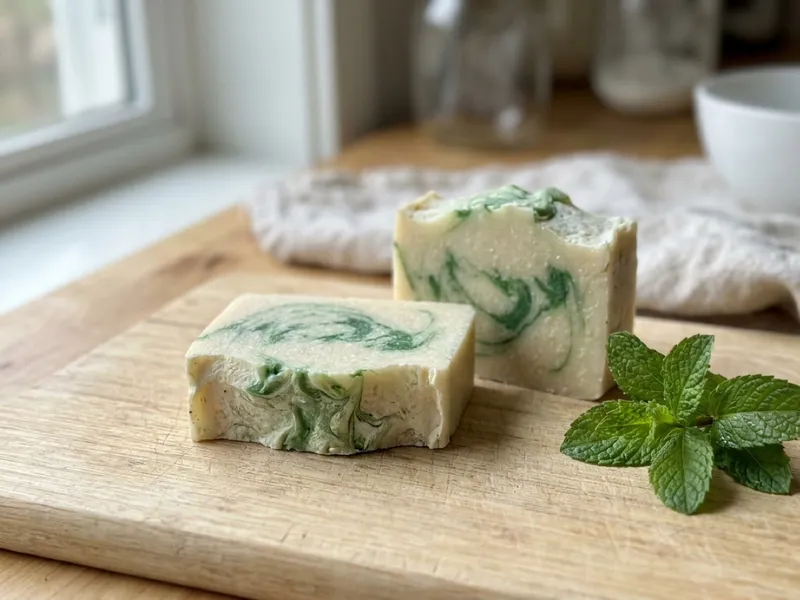
- Peppermint soap: a bright scent that shows why rate matters.
- Citrus soap: folded orange with an anchor note.
- Eucalyptus soap and tea tree soap: herbal blends.
- Fall spice soap: a careful use of low-limit spice oils.
FAQ
How much essential oil do I add to soap?
Most essential oils are used at about 1–5% of total oil weight in rinse-off soap, depending on the oil. For 1000 g of oils, 3% is 30 g. Check each oil's limit on the supplier's SDS or IFRA guidance before you settle on a number.
When do you add essential oil to cold process soap?
Most makers stir it in at light trace. You can also add it to the oils before the lye goes in, which gives more working time with oils that are known to speed up trace.
Why does my soap not smell of the essential oil after cure?
Some oils fade quickly in soap, especially single-fold citrus. Use folded citrus, anchor light oils with a base note like patchouli or cedarwood, and use the full allowed rate rather than a cautious splash.
Which essential oils should I avoid in soap?
Cinnamon bark and cassia are commonly avoided because of their low skin-safety limits. Clove is used only in small amounts. Always check the supplier's documentation for the specific oil.
Comments
No comments yet. Made this recipe? Be the first to say how it went.