Lavender Soap Recipe (Cold Process, Essential Oil)
A soft-lathering everyday bar scented with 4% lavender essential oil, kept purple with ultramarine instead of buds.
This page has affiliate links. We earn a small commission at no cost to you. Disclosure
Formula not yet verified. These numbers haven't been re-run by a second maker. Don't make this batch until this notice is gone.
- Yield
- 10 bars
- Method
- Cold process
- Difficulty
- Beginner
- Cure
- 4 weeks
- Superfat
- 5%
- Lye conc.
- 33%
On this page
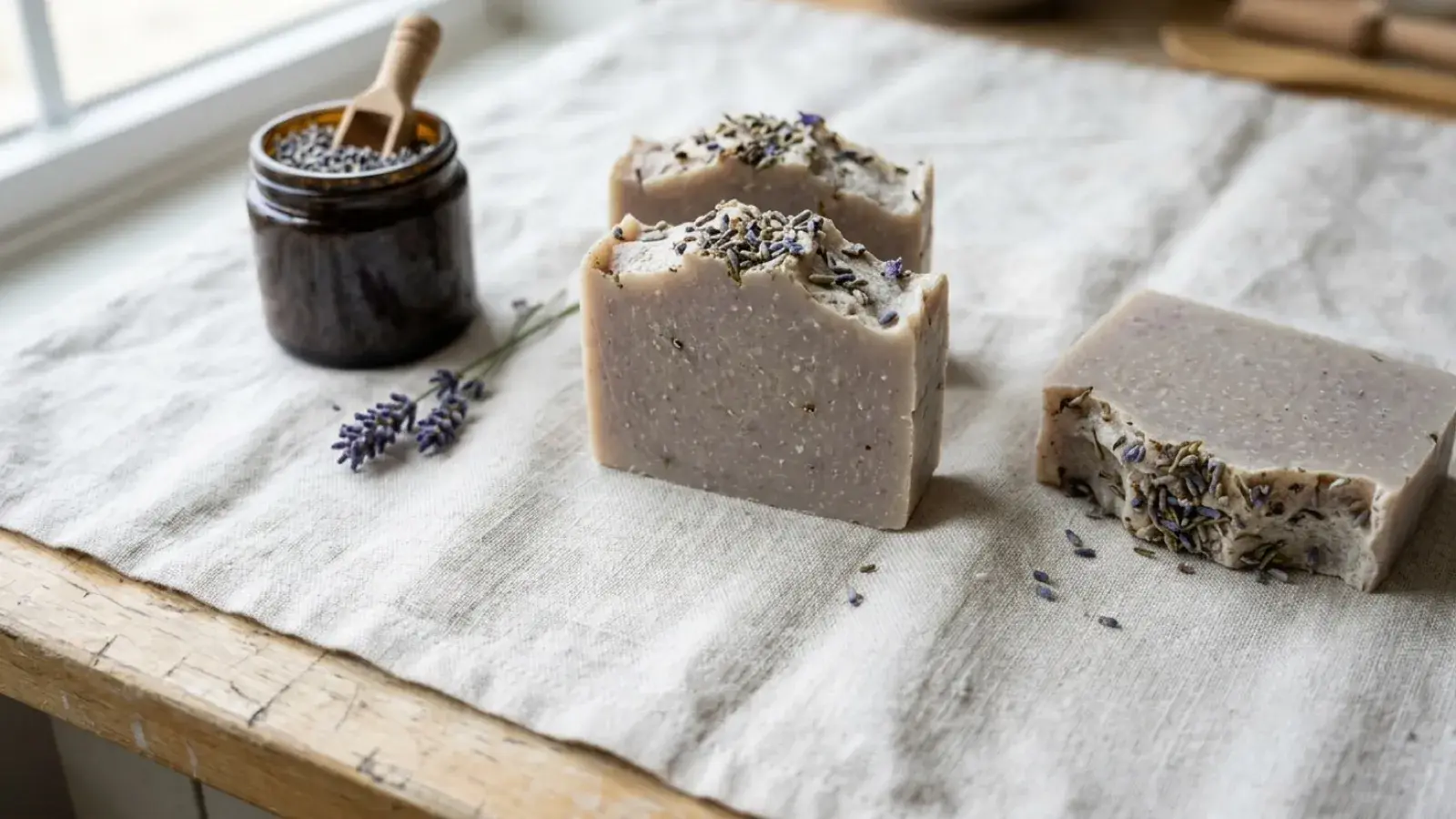
This lavender soap recipe makes a mild, palm-free bar scented with 4% lavender essential oil, about 40 g per 1000 g of oils. The color comes from ultramarine violet rather than plant material, and the buds stay on top. That keeps the bar purple instead of flecked with brown.
Lavender is a forgiving first scent. It doesn’t speed up trace or overheat the loaf. It lasts through the cure better than most top-note oils, and it blends with nearly everything. The one choice that really matters here is which lavender you buy.
Choosing the lavender oil
Most soap suppliers sell three things under the lavender name. True lavender (Lavandula angustifolia, sometimes sold by origin as French or Bulgarian) is the softest and sweetest, and the most expensive. Lavandin (Lavandula × intermedia) is a hybrid with a sharper, slightly camphor-like scent. It costs much less and is very common in commercial soap. Lavender 40/42 is a standardized blend made so every batch smells the same. Many soap makers like it because it holds up well in cold process.
All three work at the same 4% in this recipe. If you’re making bars to sell, use the name on your supplier’s label, and keep the supplier’s safety data sheet with your batch records. Our essential oil usage chart lists the rates we use. Read the essential oils guide for why soap needs weights, not drops.
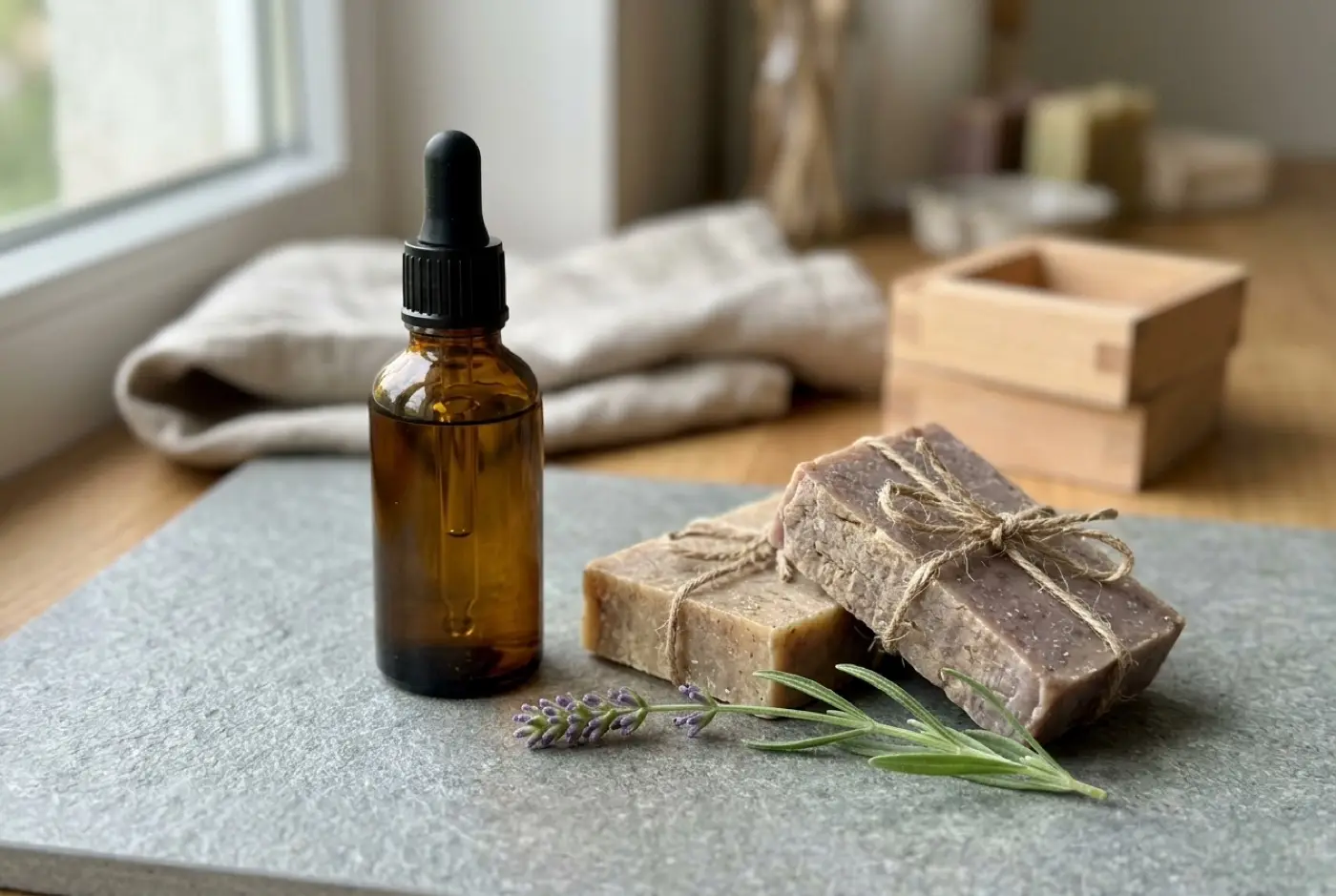
Buds are where most lavender bars go wrong. Dried buds stirred into the batter turn brown, and a whole loaf of them can look like dirt. If you love the look, press a few into the top after pouring. If you want purple all the way through, use ultramarine violet, which is stable in lye.
Why this recipe works
- Olive + sweet almond, 55%. Mild, conditioning oils that trace slowly, so there is time to add the essential oil and color without rushing.
- Coconut, 25%. Lather and hardness. Enough for a bubbly bar without the tight feel of higher coconut.
- Shea, 15%. A firmer, longer-lasting bar with a creamier lather.
- Lavender at 4%. Strong enough to survive the cure and still smell like lavender in the shower, and under the 5% upper limit in our usage chart.
Ingredients
| Oil | % | Grams | Ounces |
|---|---|---|---|
| Olive oil | 40% | 400 g | 14.11 oz |
| Coconut oil (76°) | 25% | 250 g | 8.82 oz |
| Shea butter | 15% | 150 g | 5.29 oz |
| Sweet almond oil | 15% | 150 g | 5.29 oz |
| Castor oil | 5% | 50.0 g | 1.76 oz |
| Lye solution | |||
| Sodium hydroxide (NaOH) 5% superfat | 138 g | 4.88 oz | |
| Distilled water 33% lye concentration | 281 g | 9.92 oz | |
| Additives | |||
| Lavender essential oil 4% of oil weight. True lavender (Lavandula angustifolia) or lavender 40/42. | 4% | 40.0 g | 1.41 oz |
| Ultramarine violet Optional. Disperse in 1 tsp of the olive oil before adding. | 0.1% | 1.0 g | 0.04 oz |
| Dried lavender buds Optional. Sprinkle on top only, not stirred in. | 0.2% | 2.0 g | 0.07 oz |
Equipment
Instructions
Step 1: Make the lye solution and let it cool
Put on goggles and gloves. Pour the lye into the distilled water, never the reverse, and stir until clear. Set it somewhere safe to cool to about 100°F (38°C), roughly 30–45 minutes.
Step 2: Melt and combine the oils
Melt the coconut oil and shea butter on low heat, then stir in the olive, sweet almond and castor oils. Aim for 95–105°F (35–41°C). Weigh the lavender essential oil into a small glass cup and set it aside.
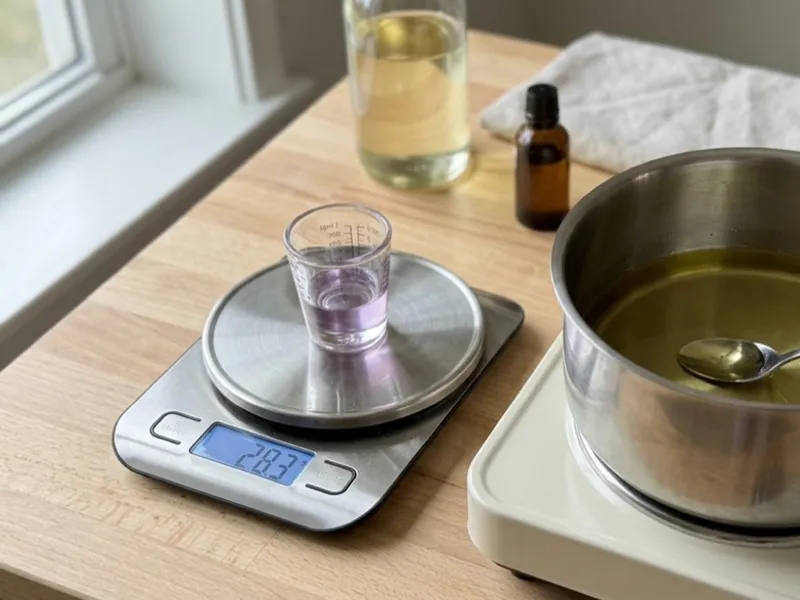
Step 3: Disperse the color
If you want a purple bar, stir the ultramarine violet into a teaspoon of the olive oil until there are no specks. Ultramarine is color-stable in lye, so the shade you see at trace is close to the shade you'll get.
Step 4: Blend to light trace, then add the lavender
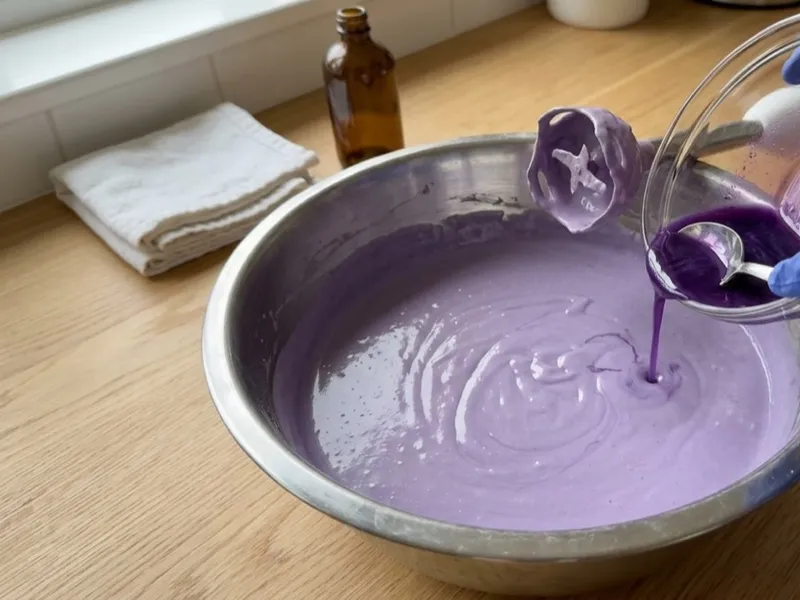
Pour the lye solution into the oils and stick blend in short bursts with stirring in between. At light trace (a faint trail on the surface, usually 1–3 minutes), stir in the lavender essential oil and the dispersed color by hand or with one or two quick pulses.
Step 5: Pour and top
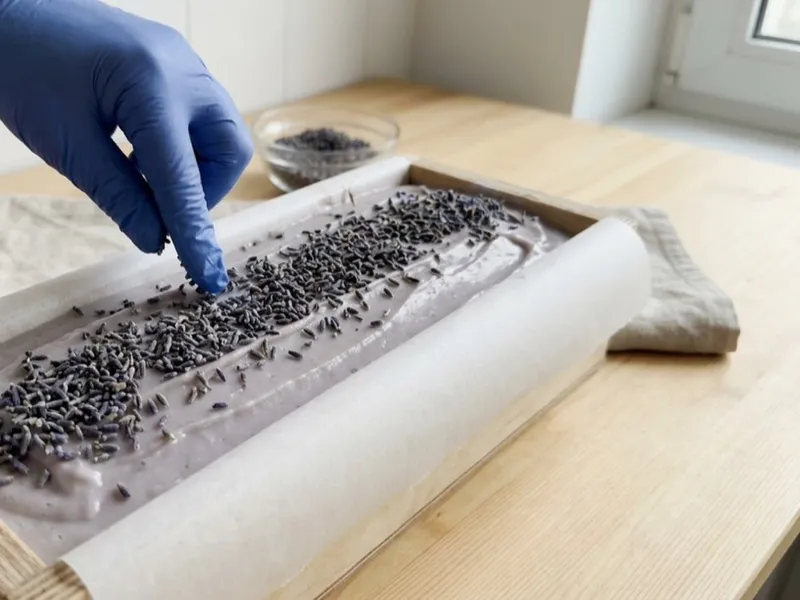
Pour into the mold and tap it on the counter to release air. If you're using buds, sprinkle them on top now and press them in gently with a gloved hand so they don't fall off when cut.
Step 6: Insulate lightly, then unmold
Cover the mold with cardboard and a towel. Lavender behaves well and doesn't speed trace or overheat. Unmold after 24–48 hours, when the loaf feels firm and no longer tacky.
Step 7: Cut and cure
Cut into bars about 1 inch (2.5 cm) thick. Cure on a rack with airflow for 4 weeks, turning the bars once a week. The scent settles and rounds off over the cure.
Variations
Lavender and cedarwood
Drop lavender to 30 g and add 15 g cedarwood (Atlas) per 1000 g oils. Cedarwood anchors lavender so it lasts longer and reads woodier.
Lavender and orange
25 g lavender plus 15 g 10-fold sweet orange per 1000 g oils for a brighter, softer scent. Lavender anchors the orange.
Fragrance oil
Swap the essential oil for a skin-safe lavender fragrance oil at the supplier’s recommended rate. Check whether it accelerates trace before you commit a full batch.
If something goes wrong
- Buds turned brown inside the bar
- Lavender buds discolor in contact with high-pH batter. Keep them on top only, where they stay purple-gray, or skip them.
- Purple faded to gray
- Plant colors like alkanet morph in lye. Ultramarine violet holds. If you used a mica, check that it is rated for cold process. Fading and morphing color
- Scent is weak after cure
- Make sure you weighed, not measured by volume, and that the oil was lavender, not lavandin labeled as lavender. Adding at light trace rather than into hot oils also helps.
FAQ
How much lavender essential oil do I put in soap?
This recipe uses 4% of oil weight, which is 40 g per 1000 g of oils. A typical range is 3–5%. Our essential oil usage chart lists 5% as the upper limit for lavender in rinse-off soap.
Why do lavender buds turn brown in soap?
The high pH of fresh soap batter darkens them. Buds mixed into the batter usually turn brown or black specks. On top, where they don't touch much batter, they hold up better.
Can I use lavandin instead of lavender?
Yes. Lavandin is cheaper and has a sharper, more camphor-like scent. It works at the same rate. Label it honestly as lavandin.
Does lavender essential oil speed up trace?
Not usually. It's one of the better-behaved essential oils, which is why it's a common first scent for new makers.
Comments
No comments yet. Made this recipe? Be the first to say how it went.