Liquid Soap Making: KOH Paste, Dilution and Clarity
Liquid soap making from scratch with potassium hydroxide. Cook a KOH soap paste, test it, dilute it to a clear liquid, and thicken and scent it without clouding.
On this page
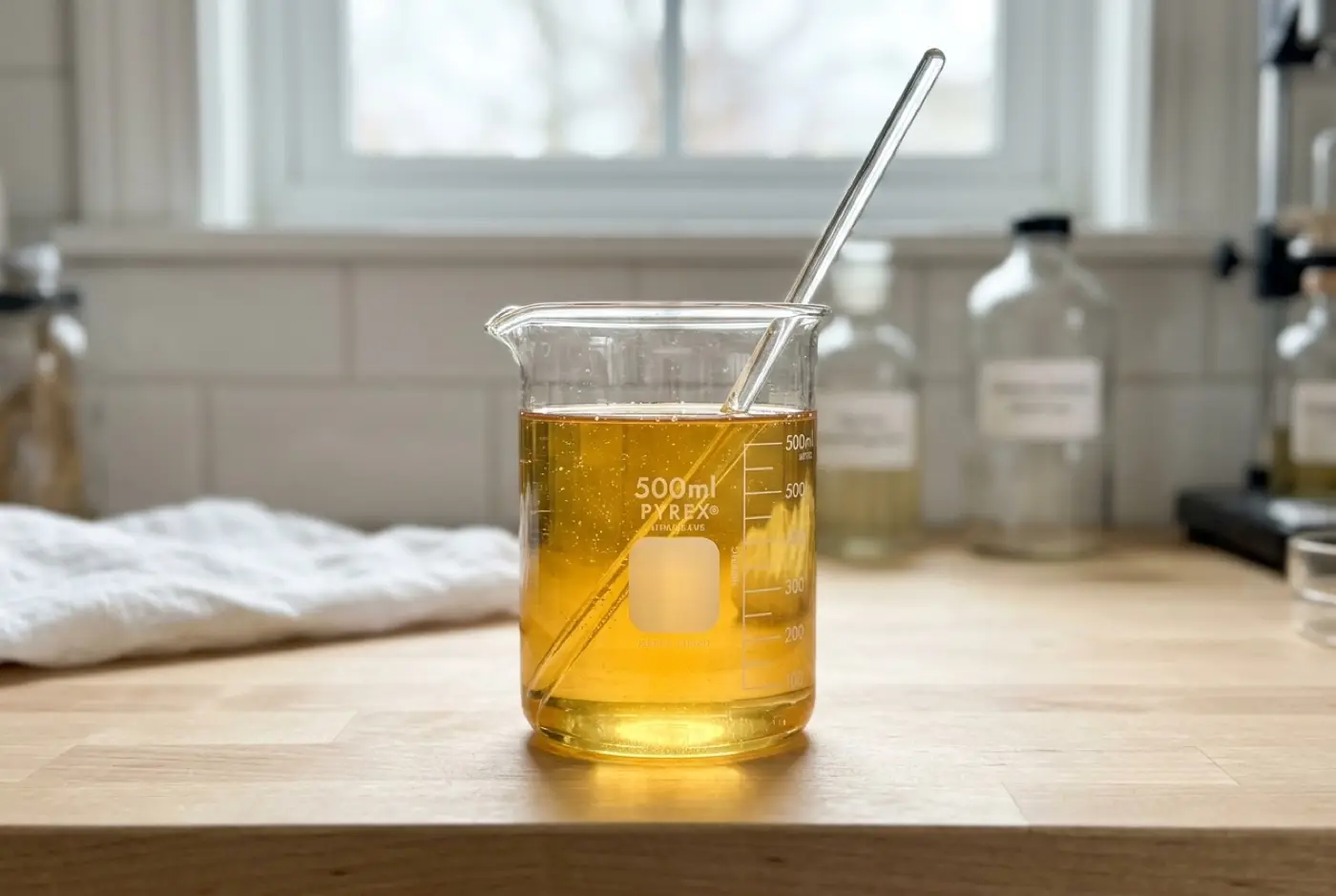
Liquid soap making from scratch is a two-stage job: first you cook oils with potassium hydroxide (KOH) into a thick, translucent soap paste, then you dilute that paste with water until it’s a pourable liquid. The paste stage is like hot process with a different lye; the dilution stage is where you control thickness and clarity. Plan an afternoon of mostly hands-off cooking, then a day or more for the paste to dissolve and settle.
What liquid soap is, and who it’s for
Bar soap is made with sodium hydroxide. Liquid soap is made with potassium hydroxide. Potassium soaps are far more soluble in water, so instead of setting into a bar they form a soft paste that dissolves into a clear or slightly hazy liquid. Sodium vs potassium hydroxide explains the chemistry and the conversion.
That’s different from “liquid soap” made by grating a bar into hot water, which tends to turn gloopy or separate. True liquid soap stays liquid.
Liquid soap making suits you if you:
- Want refills for hand soap, foaming pumps or dish soap.
- Have made bar soap and enjoy hot process.
- Like the idea of making one batch of paste and diluting it a little at a time over months.
Pros and cons vs other methods
Best for Makers comfortable with lye who want refillable hand, foaming or dish soap from their own oils.
Pros
- + One batch of paste makes a lot of liquid soap
- + Full control over oils and scent
- + Paste stores compactly until you dilute it
- + No cure in the bar soap sense
Cons
- − Uses potassium hydroxide, a second lye to buy and store
- − Long cook and harder to judge when done
- − Clarity and thickness take practice
- − Diluted soap usually needs a preservative
Equipment and ingredients
- Potassium hydroxide (KOH) flakes. Usually sold at about 90% purity. Our lye calculator assumes 90% when you switch it to KOH.
- Oils. Many liquid soaps are built around olive and coconut oil, often with some castor or sunflower. Coconut gives a thinner, bubblier soap; olive gives a milder, often thicker one.
- Distilled water, for the lye solution and for dilution. Tap water minerals can cloud the soap.
- Slow cooker used only for soap, with a low setting. The paste rises and expands during the cook, so choose one that your batch fills no more than about halfway.
- Stick blender, heat-safe #5 PP or stainless lye pitcher, sturdy spatula, digital scale in 1 g steps.
- Goggles, nitrile gloves and long sleeves.
- Lidded container for diluting, and bottles or pumps for the finished soap.
- Optional: a preservative suitable for high-pH soap, salt for thickening, fragrance or essential oils.
Setting up the recipe
Run every liquid soap recipe through the lye calculator with KOH selected. Three settings differ from bar soap:
- Superfat is low. Usually 0–3%. Extra oil doesn’t hide inside a clear liquid the way it does in a bar; it floats, clouds the soap or forms a layer on top.
- Purity matters. KOH is typically about 90% pure. The calculator adjusts for this; hand calculations often forget to.
- Water for the lye solution. Many liquid soap makers dissolve KOH in roughly three times its weight in water, about a 25% lye concentration. Follow your recipe or set it in the calculator.
For a fully worked olive and coconut example, see the conversion table on sodium vs potassium hydroxide.
The walkthrough
1. Weigh and make the KOH solution
Gear up. Weigh the oils into the slow cooker and the KOH and water into separate containers. In a ventilated spot, add the KOH to the water slowly, stirring. It heats sharply and can bubble or crackle as it dissolves; step back from the fumes.
2. Warm the oils and blend to trace
Warm the oils in the slow cooker on low. Carefully pour in the KOH solution and stick blend in bursts. KOH soap behaves differently from bar soap at this point: it often looks as if it’s separating, with a layer of oily liquid, before it suddenly thickens. Keep blending in bursts and stirring between them. Trace here is thick, more like a heavy custard or taffy than a pudding.
3. Cook to a paste
Put the lid on and leave it on low. Stir every 20–30 minutes, scraping the sides. The paste goes through stages like hot process soap: opaque and creamy, then puffy and foamy, then increasingly translucent and stiff, like taffy or petroleum jelly. Cooking can take a few hours, depending on the oils and the cooker.
The paste is ready to test when it looks evenly translucent with no opaque streaks.
4. The clarity test
This is the step that tells you whether the cook is finished.
- Put a small piece of paste, about the size of a pea or a teaspoon, into a cup of very hot distilled water.
- Stir until it dissolves.
- Look at it against the light.
| What you see | What it usually means | What to do |
|---|---|---|
| Clear, or slightly hazy and see-through | The cook is done | Dilute |
| Milky or white | Unsaponified oil: the cook isn’t finished | Keep cooking, test again every 30 minutes |
| Oily film on the surface | Excess oil, either unfinished cook or superfat too high | Cook longer; if it persists, lower the superfat next time |
| Hazy but no oil, and stays that way | Often harmless, from the oils used or from minerals | Dilute; it may clear as it rests |
Oils and formulas vary: some finished soaps are naturally a little hazy. The thing you’re looking for is the difference between a soft haze and a milky, oily cloud.
5. Dilute the paste
Weigh the finished paste. Put it in a lidded container and add hot distilled water. A common starting point is somewhere between an equal weight of water and a few times the paste’s weight, depending on the oils and how thick you want the result. Coconut-heavy pastes often need more water; olive-heavy ones need less.
Start with less water than you think you need: it’s easy to add water and hard to take it out. Cover and leave it. The paste dissolves slowly, often over several hours or overnight. Gentle warmth helps. Stir occasionally, then add more water a little at a time until you reach the thickness you want.
6. Rest, thicken and scent
Rest it. Leave the diluted soap covered for several days to a couple of weeks. Any fine haze or excess oil tends to settle or rise; you can pour or ladle the clear soap off. This resting is sometimes called sequestering.
Thicken if you want. Dissolve some salt in hot distilled water to make a strong salt solution. Add a small amount, stir, and wait a few minutes before judging, because it thickens gradually. Salt works well on some formulas, especially coconut-heavy ones, and barely at all on others. Too much salt thins the soap again or turns it cloudy, so go slowly.
Scent it. Add fragrance or essential oil to the diluted soap at your supplier’s rate. Some fragrances cloud liquid soap or make it separate; test a small amount first.
Preserve it. Diluted soap is mostly water and gets handled in use. Many makers add a preservative suited to high-pH soap, at the supplier’s rate, especially if they add any extras.
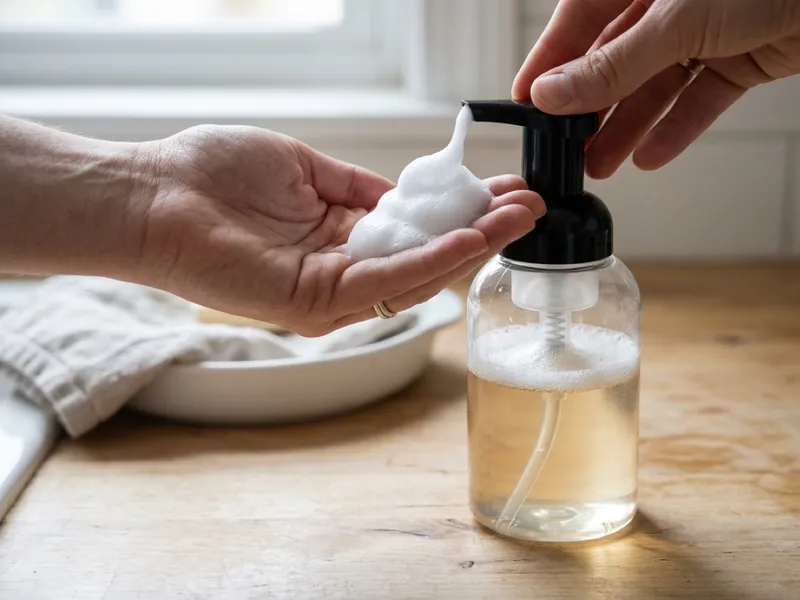
For foaming pumps, dilute further. A foaming soap needs to be thin enough for the pump to aerate, so it’s much more dilute than a hand soap you’d squeeze from a bottle. See foaming hand soap.
When the cook misbehaves
KOH paste has its own set of alarming-looking moments. Most are normal.
| What happens | What it usually means | What to do |
|---|---|---|
| Batter separates into an oily layer after blending | Normal early stage for KOH soap | Keep blending in bursts; it comes together |
| Paste foams up and rises in the cooker | Normal during the cook | Stir it down; don’t leave the cooker |
| Paste gets too stiff to stir | Normal as it nears done | Mash and fold rather than stir; it’s nearly ready |
| Paste stays opaque after hours | Cook not finished, or heat too low | Keep cooking; check the cooker is actually warm |
| Clarity test stays milky after a long cook | Possible excess oil from a calculation or weighing error | Re-check the recipe in the calculator before adding anything |
Storing paste and finished soap
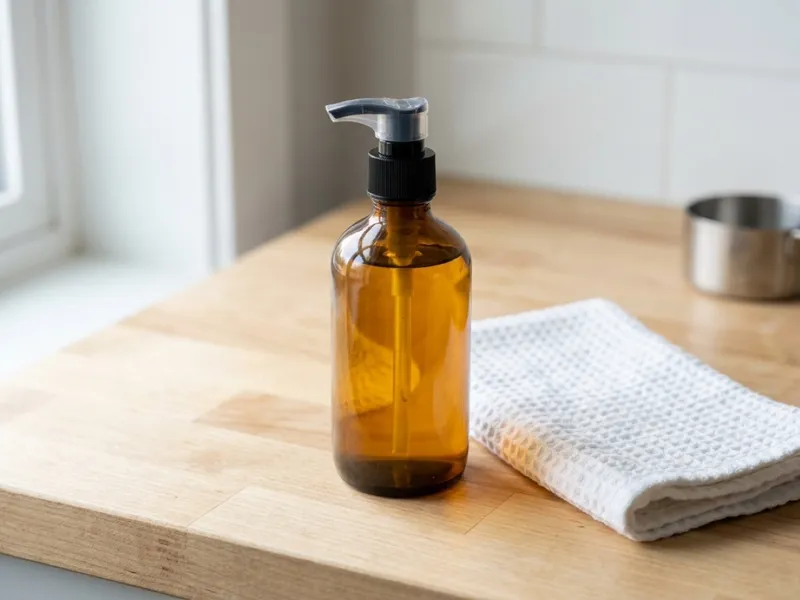
Undiluted paste keeps well in a sealed, labeled jar out of reach of children and pets; label it as soap paste so nobody mistakes it for food. Diluted soap is best stored in clean bottles with pumps or flip caps, away from direct sunlight, which can fade colors and fragrance. Wash and dry bottles before refilling; don’t top up old soap with new.
Common mistakes
- Using sodium hydroxide. You’ll get a solid or a gloopy, separating gel. Liquid soap needs KOH.
- Using the NaOH number with KOH. KOH needs about 1.4 times as much by weight, and more for its purity. Switch the calculator to KOH.
- Superfat too high. A bar-soap 5% superfat often leaves cloudiness or an oily layer. Stay at 0–3%.
- Stopping blending when it seems to separate. That’s normal for KOH soap. Keep going.
- Diluting too soon. Skip the clarity test and you may be diluting unfinished soap.
- Adding all the water at once. You can end up with soap far thinner than you wanted.
- Adding salt quickly. Thickening is slow and easy to overshoot.
A starter recipe
Our liquid hand soap is built for a first batch of paste, with weights for oils, KOH and water and a dilution guide. For a thinner soap for pumps, see foaming hand soap.
If you’d like to design your own, start simple: olive and coconut oil, a superfat of 0–3%, KOH selected in the lye calculator.
Next steps
- Understand the lye: sodium vs potassium hydroxide.
- Use your paste skills for cleaning: homemade dish soap and laundry soap.
- Combine both lyes in a single soap with cream soap, an advanced project.
FAQ
Can I make liquid soap with sodium hydroxide?
Not true liquid soap. Sodium soaps are hard and won't stay dissolved at a useful concentration. Liquid soap needs potassium hydroxide (KOH).
Is grated bar soap in water the same as liquid soap?
No. Grated bar soap dissolved in water often turns gloopy or separates as it cools. True liquid soap is made with KOH, which forms soap that stays dissolved.
Why is my liquid soap cloudy?
Usually from extra oil (superfat that's too high), an unfinished cook, hard water, or a fragrance that doesn't dissolve well. Resting the diluted soap often lets haze settle out.
How do I thicken homemade liquid soap?
Add a salt solution a little at a time, stirring and waiting between additions. It works better on some formulas than others, and too much salt thins the soap again.
Do I need a preservative in liquid soap?
Many makers add one, because diluted soap is mostly water and can be contaminated in use. It matters more if you add botanicals or other extras. Use a preservative rated for high-pH soap and follow the supplier's rate.
Comments
No comments yet. Made this recipe? Be the first to say how it went.