Soap Embeds: How to Make and Place Shapes Inside Cold Process Soap
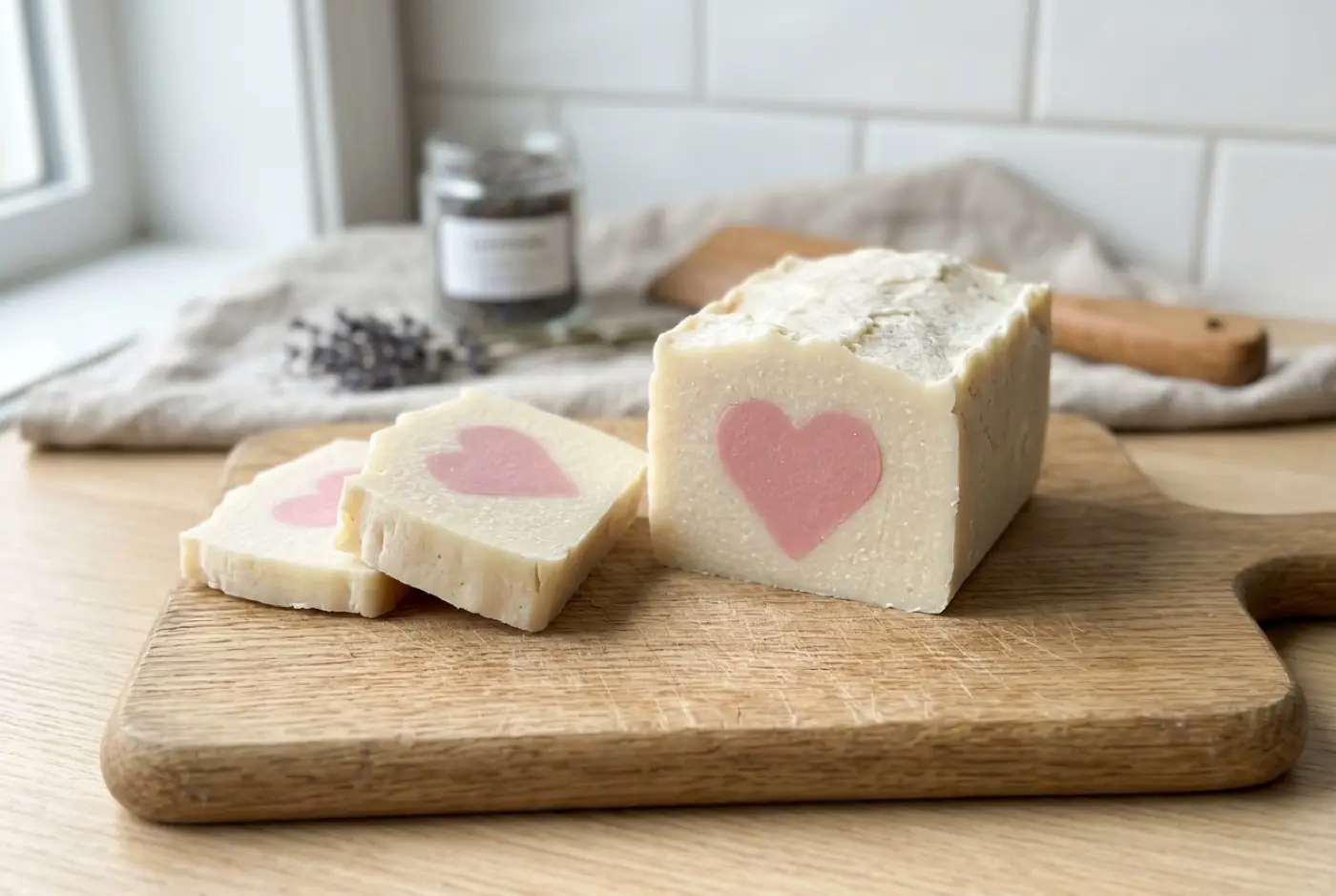
Soap embeds are pieces of finished soap set into fresh batter so a shape shows in every bar or on top of the loaf. Here's how to make embeds, the trace to pour around them, and how to keep them from floating, gapping or falling out.
On this page
- Cold process or melt and pour embeds?
- Is it the right technique for you?
- Making the embeds
- Batter thickness for placement
- Walkthrough: a tube embed through the middle
- Account for the space embeds take up
- Cutting through embeds
- Embed ideas worth trying
- Top embeds
- Common mistakes
- A starter embed project
- Next steps
- FAQ
Soap embeds are pieces of finished soap that you set into fresh batter, so a shape shows inside every bar or sits on top of the loaf. Make them a day or more ahead, trim them to fit, and pour batter around them: thin trace to fully encase a long “tube” embed, medium trace to hold embeds suspended at a set height. The choice that matters most is what you make the embeds from, because cold process and melt and pour embeds behave differently once the loaf heats up and cures.
Embeds turn a simple loaf into something people pick up at a market table. They also add a few new ways for a batch to go wrong, which this guide covers.
Cold process or melt and pour embeds?
This is the decision that shapes everything after it.
| Cold process embeds | Melt and pour embeds | |
|---|---|---|
| Detail and color | Softer edges; colors can morph with some fragrances and colorants | Crisp detail; bright, stable colors |
| Through gel phase | Handle heat well | Can soften, warp or bleed color if the loaf gets hot |
| During cure | Shrink along with the surrounding soap | Don’t lose water the same way, so a gap can sometimes form |
| In humid conditions | Behave like the rest of the bar | Glycerin-rich bases can sweat on the surface |
| Best for | Tube embeds through the middle, chunks, confetti | Small detailed shapes, especially on top of the loaf |
If you’re new to embeds, cold process embeds through the middle of a loaf are the most predictable. Melt and pour embeds work well too, especially as top decorations, but keep the loaf from getting too hot. Chilling or skipping insulation (see gel phase) protects them.
Is it the right technique for you?
Best for Makers who want a recognizable shape in every bar, or decorated tops for gifts and markets.
Pros
- + A design that shows in every cut bar
- + Uses up scraps and end pieces
- + Works at medium trace, so timing is relaxed
- + Combines with layers and swirled tops
Cons
- − Needs planning a day or more ahead
- − Embeds can float, gap or fall out
- − Melt and pour embeds can warp in a hot loaf
- − Cutting through mixed hardnesses takes care
Making the embeds
Tube embeds run the full length of the loaf, so every bar shows the same shape in cross-section.
- Use a tube mold, a section of PVC pipe lined with freezer paper, or a column mold made for soap.
- Pour cold process batter into it, let it set, and unmold after a day or two. Long, narrow embeds can take longer to firm up than a full loaf.
- Trim the tube to the length of your mold.
Shaped embeds and chunks
- Pour batter into small silicone cavity molds (hearts, stars, leaves) and unmold once firm.
- Cut chunks from scrap bars or loaf ends for confetti-style soap.
- For melt and pour, melt the base, color it, pour into detailed molds, and pop them out once fully set.
Timing. Make embeds at least a day ahead so they’re firm enough to handle. Very old, fully dried embeds bond less well than embeds made within the past week or two; if you’re using older embeds, lightly scuff the surface before placing them.
Batter thickness for placement
- Thin to light trace to fully encase a tube embed lying at the bottom or middle of the mold. Fluid batter fills in around it without trapping air.
- Medium trace to suspend embeds at a set height or keep them upright. Thicker batter holds them still.
- Thick trace on top of the loaf to hold decorative embeds in place on a textured top.
Fragrances that accelerate are less of a disaster here than in a swirl, but they shorten the time you have to place embeds carefully. Stick with a fragrance you’ve tested. See fragrance oils vs essential oils.
Walkthrough: a tube embed through the middle
1. Make the embeds ahead. Pour a tube embed a day or more before the main batch.
2. Trim and plan placement. Lay the embed in the empty mold and check it fits end to end. If it sits off-center, the shape will move across the bar as you cut.
3. Mix the batter. Make your main batch and bring it to thin to light trace.
4. Pour a base layer. Pour enough batter to bring the depth up to where the embed should sit. For a centered embed, that’s roughly the height that places its middle at half the mold depth.
5. Place the embed. Lay the tube on the batter and press it down gently. Tap the mold a few times so batter fills under and around it, pushing out any trapped air.
6. Cover and finish. Pour the remaining batter slowly over a spatula, so it doesn’t push the embed sideways. Tap the mold again and finish the top.
7. Cut across the embed. After unmolding, cut perpendicular to the tube so every bar shows the shape. See unmold and cut soap.
Account for the space embeds take up
Embeds fill part of the mold, so the same amount of batter will overflow. A simple way to adjust: weigh your embeds, then reduce the batter by roughly the same weight. Soap embeds and fresh batter have similar densities, so this gets you close. A loaf with a large tube embed might need noticeably less batter than your standard recipe; a few small top embeds barely change anything.
If you’d rather not recalculate a recipe, pour any leftover batter into a small cavity mold. Those become embeds for next time.
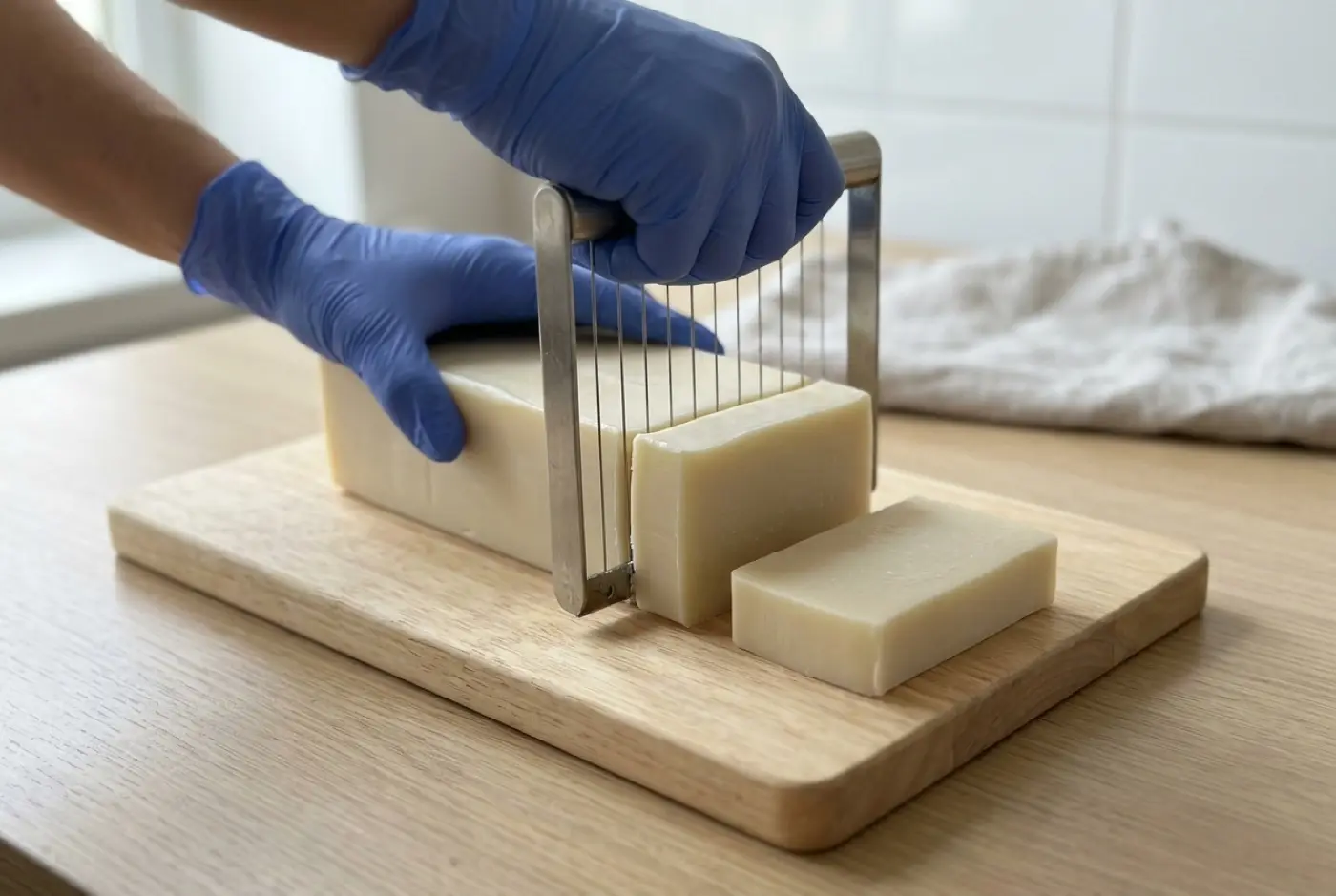
Cutting through embeds
Embeds and the surrounding soap don’t always have the same hardness, which can make cutting tricky.
- Cut on schedule. A loaf with embeds still wants cutting at the usual time; see unmold and cut soap. Waiting longer only lets the main soap catch up with harder embeds.
- Use a knife on mixed hardness. A wire cutter can deflect around a hard embed or snap. A long, sharp knife pushed straight down gives more control.
- Cut top-embed loaves on their side. Turning the loaf on its side before cutting means the blade doesn’t push decorations down into the soap or knock them off.
Embed ideas worth trying
- Confetti soap. Small cubes cut from leftover bars, folded into thick batter. A good use for loaf ends.
- Shape through the middle. A heart, star or circle tube embed that shows in every bar.
- Contrast cores. A dark charcoal tube in a pale loaf, or a white tube in a dark one.
- Seasonal tops. Small melt and pour shapes on a textured top for holidays.
Top embeds
Decorations on top of a loaf (melt and pour shapes, cold process curls, small rounds) sit on thick-trace batter.
- Pour and texture the top while the batter is at thick trace.
- Press each embed in far enough that its base is fully surrounded by batter. Embeds that sit on the surface come off with handling.
- Plan the spacing around your cut lines, so each bar gets a whole decoration rather than half of two.
Common mistakes
- Air pockets around embeds. These show as holes when you cut and weaken the bond. Use fluid batter and tap the mold.
- Dusting embeds with mica. It creates a slick layer that stops the embed from bonding.
- Floating embeds. They rise in thin batter. Place them on a slightly firmed base layer.
- Melt and pour embeds in a hot loaf. They can soften or bleed. Skip insulation, or chill the loaf.
- Ignoring cut lines. A top embed bisected by the knife looks like a mistake.
A starter embed project
Make a tube embed from a small batch of naturally colored soap (cocoa powder or a clay works well), then set it into a plain loaf of the three-oil beginner soap. For holiday tops, Christmas soap works well with small melt and pour decorations.
Next steps
- Set embeds into one layer of layered soap.
- Pour a swirl around an embed with soap swirl techniques.
- For melt and pour embed basics, see melt and pour soap.
FAQ
Can you put melt and pour embeds in cold process soap?
Yes, and many makers do. Melt and pour holds sharp detail, but it can soften or warp if the cold process loaf gets hot during gel, and it may sweat in humidity. Keeping the loaf cool helps.
How far ahead should you make soap embeds?
At least a day, so they are firm enough to cut and handle. Cold process embeds made a few days to a couple of weeks before are firm and still bond reasonably well.
Why do soap embeds fall out of the bar?
Usually a poor bond. Embeds that are very old and dry, dusted with too much mica, or set into thick batter with air around them can loosen. Pour fluid batter around them and tap the mold to remove air.
How do you keep embeds from floating?
Set them into a base layer that has firmed slightly, and pour the next batter gently over a spatula. Thicker batter also holds embeds in place better than thin batter.
Comments
No comments yet. Made this recipe? Be the first to say how it went.