Activated Charcoal Soap Recipe (Cold Process Black Bar)
A deep charcoal-gray cold process bar with peppermint and eucalyptus, and how much charcoal to use before the lather turns gray.
This page has affiliate links. We earn a small commission at no cost to you. Disclosure
Formula not yet verified. These numbers haven't been re-run by a second maker. Don't make this batch until this notice is gone.
- Yield
- 10 bars
- Method
- Cold process
- Difficulty
- Beginner
- Cure
- 6 weeks
- Superfat
- 5%
- Lye conc.
- 33%
On this page
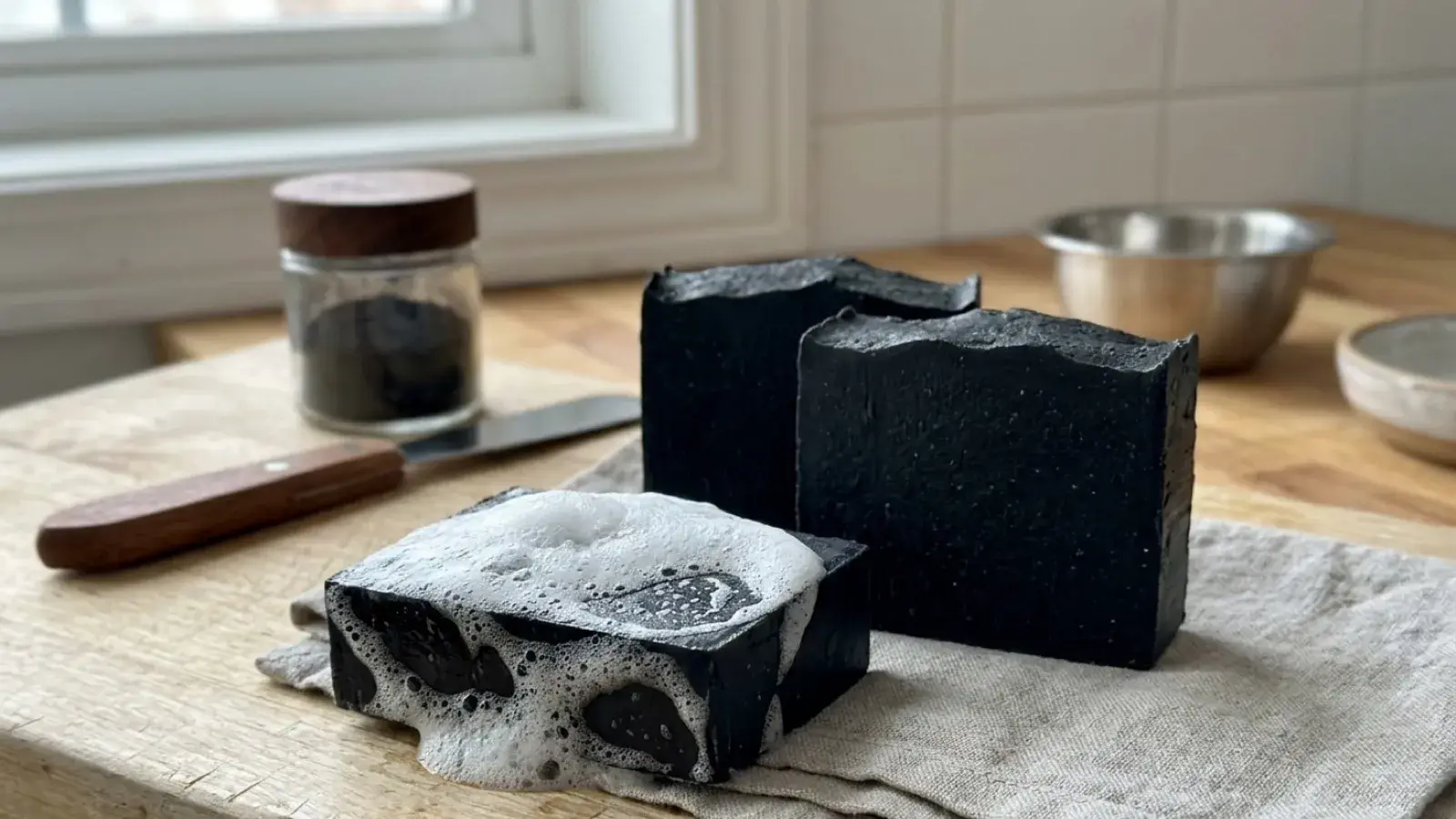
This activated charcoal soap recipe makes a near-black cold process bar with white, creamy lather and a cool peppermint-eucalyptus scent. It uses 5 g of activated charcoal per 1000 g of oils, about 0.5%, mixed into a little oil first so the color is even and speck-free. Treat charcoal as what it is in soap: a colorant, and a strong one.
The common mistake is using too much. Charcoal is light and fluffy, so a heaped spoon weighs very little, and it is tempting to keep adding until the batter looks jet black. In the mold, a little charcoal already looks dark; in the cured bar, too much makes gray lather and smudgy washcloths. Weigh it, start at 0.5%, and let the black come from even dispersion rather than quantity.
Getting a true black
Charcoal particles cling together. If you sprinkle them straight into the batter, they form tiny dry clusters that show up later as black specks or a gritty streak. Mixing the powder into a small amount of warm oil, crushing it into a smooth paste, and stick blending it through the whole pot of oils before the lye goes in avoids that. A gelled loaf looks a little glossier and deeper than one kept cool, so a light towel over the mold helps. If soda ash forms, it will be more obvious on black than on any other color.
Why this recipe works
- Olive + avocado, 50%. Conditioning oils that trace slowly, so you have time to blend the charcoal in evenly.
- Coconut, 28%. A slightly higher share than usual so the lather stays white and bubbly against the dark bar.
- Castor, 7%. Thickens and stabilizes the lather so it reads as clean white foam, not thin gray suds.
- Activated charcoal, 0.5%. Enough for a near-black bar. Past about 1%, lather starts to look gray and can mark washcloths.
Ingredients
| Oil | % | Grams | Ounces |
|---|---|---|---|
| Olive oil | 35% | 350 g | 12.35 oz |
| Coconut oil (76°) | 28% | 280 g | 9.88 oz |
| Shea butter | 15% | 150 g | 5.29 oz |
| Avocado oil | 15% | 150 g | 5.29 oz |
| Castor oil | 7% | 70.0 g | 2.47 oz |
| Lye solution | |||
| Sodium hydroxide (NaOH) 5% superfat | 139 g | 4.91 oz | |
| Distilled water 33% lye concentration | 283 g | 9.97 oz | |
| Additives | |||
| Activated charcoal powder Disperse in 15 g of the warm batch oils before blending. 2–3 g gives mid-gray; 5 g gives near-black. | 0.5% | 5.0 g | 0.18 oz |
| Peppermint essential oil 1.5% of oil weight; add at light trace. | 1.5% | 15.0 g | 0.53 oz |
| Eucalyptus essential oil 1.5% of oil weight; add at light trace. | 1.5% | 15.0 g | 0.53 oz |
Equipment
Instructions
Step 1: Make the lye solution
Put on goggles and gloves and work with ventilation. Add the lye to the distilled water, never the reverse, and stir until clear. Let it cool to about 100°F (38°C).
Step 2: Disperse the charcoal in oil
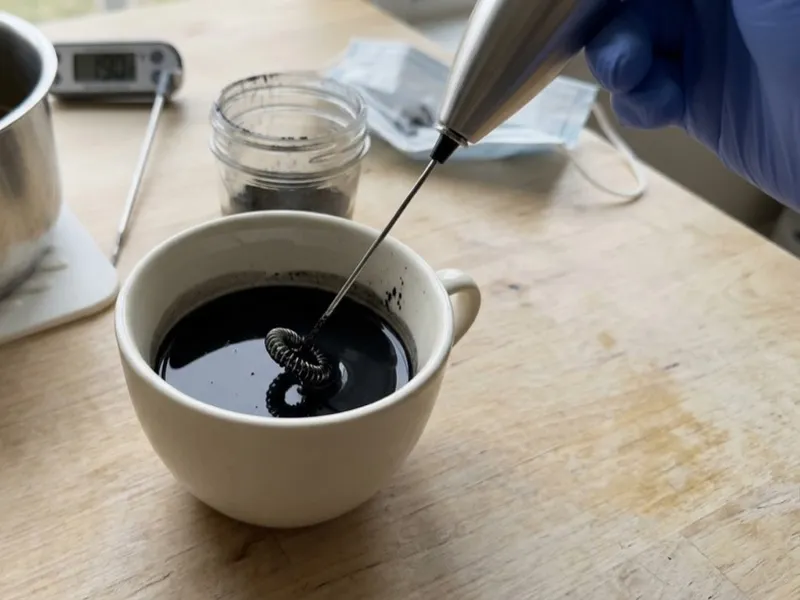
Melt the coconut and shea, add the liquid oils, and let the mix cool to 95–105°F (35–40°C). Pour about 15 g of the warm oils into a cup and add the charcoal. Stir, then mash with the back of a spoon or a mini frother until it looks like smooth black ink with no specks. Wear a mask while measuring; the powder is very light and drifts.
Step 3: Blend the charcoal into the oils
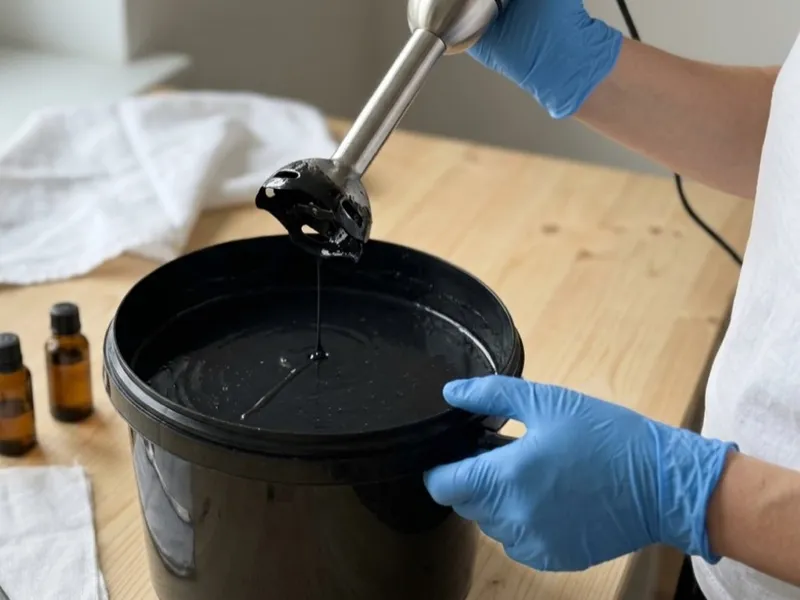
Pour the charcoal oil back into the main pot and stick blend for a few seconds before adding the lye. Coloring the oils first gives an even shade and catches any clumps while the batter is still thin.
Step 4: Blend to light trace and scent
Pour in the lye solution and blend in short bursts to light trace, when a drizzle leaves a faint line. Add the peppermint and eucalyptus essential oils and stir them in by hand, then pulse once or twice.
Step 5: Pour and insulate lightly
Pour into the mold and tap out air bubbles. Charcoal soap can gel safely; cover with cardboard and a towel for an even, glossy black. Unlike sugar additives, charcoal does not add heat.
Step 6: Unmold, cut and clean up
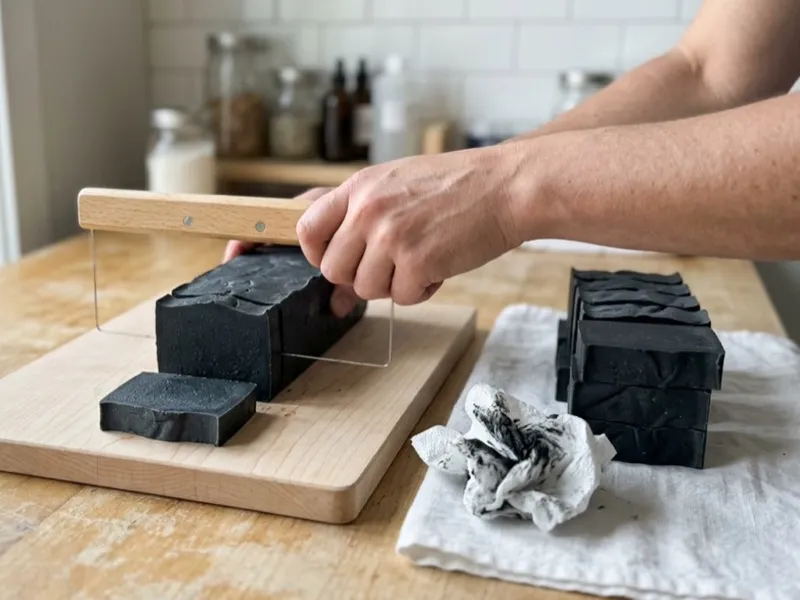
Unmold after 24–48 hours and cut into bars. Wipe tools with a paper towel before washing; charcoal can stain grout and light-colored silicone.
Step 7: Cure
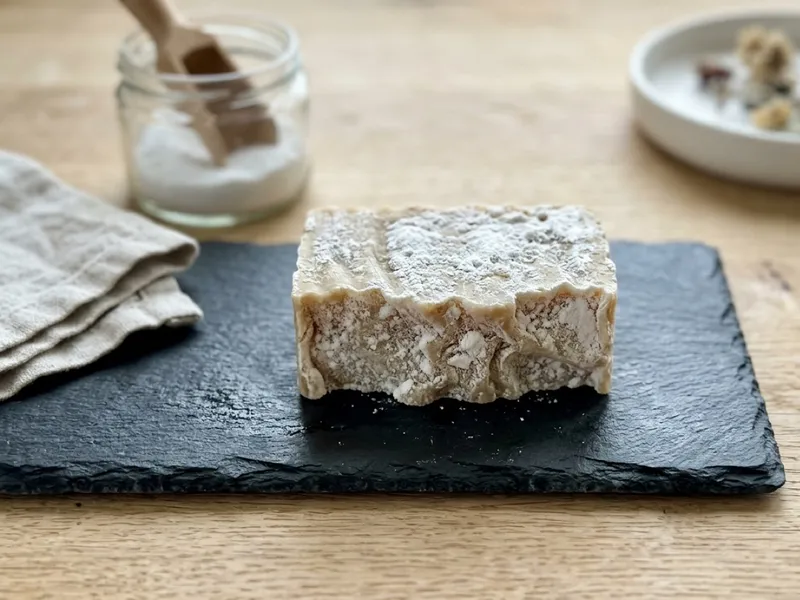
Cure 6 weeks on a rack with airflow, turning weekly. A faint white film may appear on top; steam or plane it off for a clean black finish.
Variations
Charcoal swirl
Split the batter at light trace, color one-third with all the charcoal and leave the rest plain, then pour in layers and swirl once with a chopstick.
Unscented
Skip the essential oils. The bar is just as dark and works well for anyone avoiding fragrance.
Tea tree and lavender
Swap the blend for tea tree at 1.5% and lavender at 2%, chosen for its sharp, clean scent.
If something goes wrong
- Gray lather
- Too much charcoal. Drop to 2–3 g per 1000 g of oils next time.
- Black specks or streaks
- Charcoal clumped. Disperse it fully in oil first and blend the oils before adding lye.
- White film on the black top
- Soda ash shows up starkly on dark bars. Spray the top with alcohol after pouring next time. Soda ash
FAQ
How much activated charcoal do I add to soap?
About 2–5 g per 1000 g of oils, roughly half a teaspoon to a teaspoon per pound. Start at the low end for gray and go up for black.
Can I add charcoal to the lye water?
Some makers do, but it tends to clump and is hard to see in the dark solution. Dispersing it in oil gives you a smoother, more predictable color.
Will charcoal soap stain towels?
At sensible amounts, no. Very high amounts can leave gray marks on washcloths and in the sink, which is why this recipe stays at 0.5%.
What does charcoal actually do in soap?
In this recipe it is used for color. It turns the bar dark gray to black. We do not make skin-benefit claims for it; the bar cleans like any well-made soap.
Comments
No comments yet. Made this recipe? Be the first to say how it went.