Crumbly Soap: Why Bars Crumble When Cut and What to Do
Crumbly soap means either too much lye for the oils or a hard recipe cut too late. Check your weights first: if the lye was off, the bars aren't safe to use until fixed.
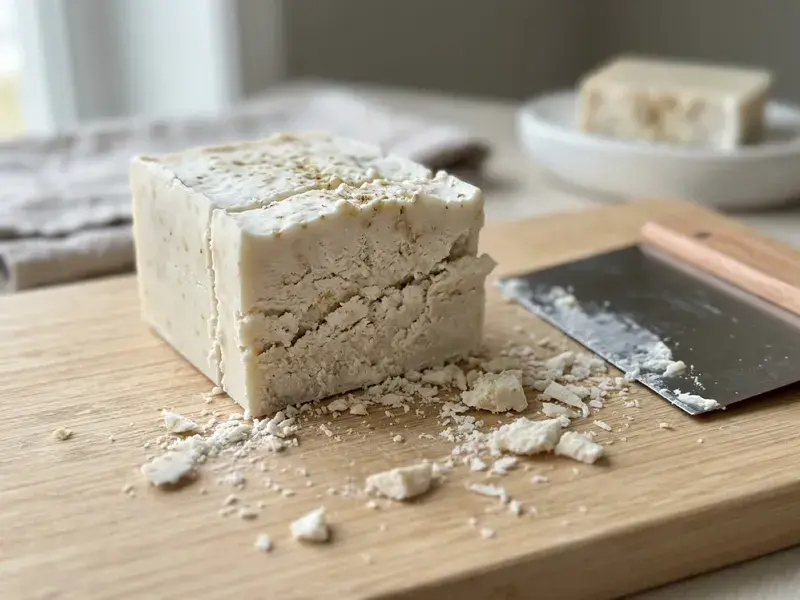
Is it safe to use?
A late cut on a hard recipe is only cosmetic. Crumbling from excess lye is not safe on skin. Check your weights against a lye calculator, then test a cured bar with pH strips before anyone uses it.
If the numbers don't add up or the test reads high, follow the lye-heavy guide. Lye-heavy soap
Causes, ranked by likelihood
- Most likely
Too much lye for the oils
A mis-weighed oil, a scale that wasn't tared, or a recipe entered with the wrong oil in the calculator leaves extra lye. Excess lye makes soap hard, brittle and harsh all the way through.
- Common
A hard recipe cut too late
Salt bars, high-coconut bars and recipes heavy in stearic acid or cocoa butter get rock hard fast. Left a day or two too long, they shatter under the knife even when the lye is correct.
- Sometimes
Batter was too cool or barely mixed
Hard butters can start to solidify in cool batter and give a false trace. The poured soap sets unevenly and can be brittle and chalky in patches.
Fix this batch
Check the numbers before you check the bars
- Find your batch notes and re-enter the exact weights you used in a lye calculator. If the superfat comes out at 0% or below, treat the batch as lye heavy.
- If the numbers are fine, cut the rest of the loaf now, with a wire cutter or a warmed knife, before it gets any harder.
- Cure the bars four to six weeks in an airy spot, then confirm with pH strips before using them.
- If the lye was off, rebatch with enough extra oil to bring the superfat back to about 5%, or discard the batch.
Prevent it next time
Weigh carefully and cut on time
- Run every recipe through a lye calculator and double-check that the oils and lye type (NaOH for bars) match what you'll actually use.
- Weigh each oil into a tared container and tick it off a printed list as you go.
- Cut salt bars within a few hours, as soon as they hold their shape, and check hard recipes at 12 to 24 hours.
- Keep batter around 90–110°F (32–43°C) when the recipe has a lot of hard butter, so it doesn't false trace.
Two loaves, two answers
The fastest way to sort this out is the batch log, not the bar. Two loaves can crumble the same way for opposite reasons.
A salt bar cut the next morning shatters because it did exactly what salt bars do. Its numbers are fine, and once trimmed it’s a good bar. A three-oil loaf that crumbles and feels harsh after three days is a different story, especially if you remember the scale wobbling or a jug of oil running short. Re-run what you actually weighed, not what you meant to weigh.
If you didn’t log the batch, don’t guess. Let a bar cure, then test it with pH strips or a few drops of phenolphthalein before it goes near skin. Our lye calculator shows the superfat for the weights you enter, and a batch log makes this check take two minutes next time.
The science behind it
FAQ
Is crumbly soap always lye heavy?
No. Hard recipes cut late crumble even with perfect numbers. The difference is that lye-heavy soap is harsh to the touch and tests high on pH strips; a late-cut bar just looks rough.
Can I still use crumbly soap?
If your weights check out and a cured bar tests normally, yes. Plane or bevel the rough edges. If you can't confirm the numbers, don't use it until you've tested it.
Why did my salt bar crumble?
Salt bars set very quickly and get brittle within hours. Most makers cut them as soon as they're firm, often 1–4 hours after pouring, or pour them into individual cavity molds so they never need cutting.
Will crumbly soap get better as it cures?
A late-cut bar won't get less crumbly, but the rough edges can be trimmed. A lye-heavy bar won't fix itself with time; the excess lye has nothing left to react with.
Comments
No comments yet. Made this recipe? Be the first to say how it went.