Soap Ricing: Why Batter Turns Lumpy and How to Smooth It
Ricing is when part of the batter, usually reacting with a fragrance oil, sets into small hard lumps while the rest stays fluid. Stick blend hard to break the lumps up, then pour.
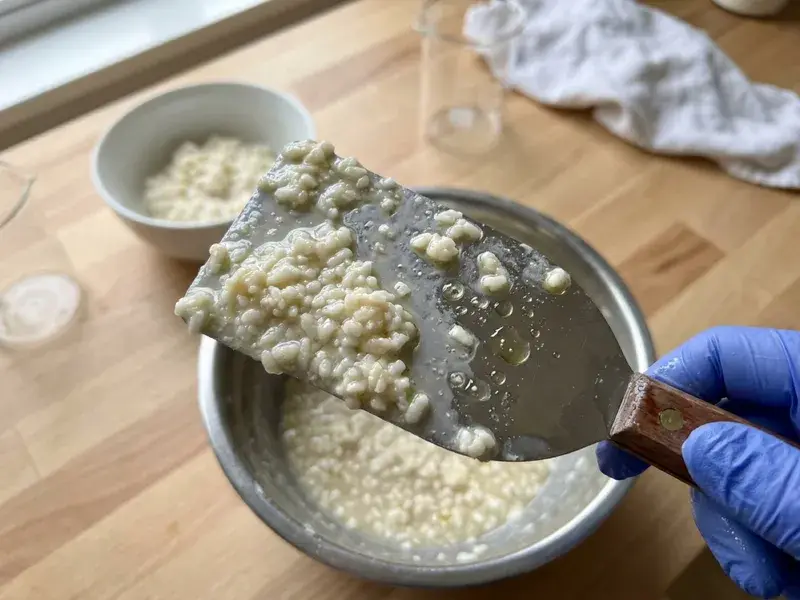
Is it safe to use?
If you blended the lumps out and the batter came back together, the soap is usually fine after cure. Lumps poured as they were can hide unmixed lye, so cut a bar and check for pockets or crystals before use.
Found wet spots or white crystals after cutting? Lye pockets
On this page
Causes, ranked by likelihood
- Most likely
A fragrance oil reacted with the batter
Certain fragrance and essential oil components react with the oils or lye and make some of the batter set early. Supplier notes often mention ricing.
- Common
Hard oils were too cool
If butters like shea, cocoa or stearic-rich oils weren't fully melted or cooled too far, they can form grains that look like ricing.
- Sometimes
Large temperature gap between lye and oils
Adding very warm lye solution to cool oils, or the reverse, can make hard oils solidify in places as the two meet.
Fix this batch
Blend through it
- Keep going. Switch the stick blender on and blend in longer bursts, pressing it into the lumps.
- Blend until the batter is smooth again. It will be thicker than before, so skip any intricate design.
- Spoon or glop it into the mold and tap the mold firmly to settle it.
- If lumps won't break up, cook the batch as hot process until it looks like petroleum jelly, then mold it.
Prevent it next time
Test and temper
- Check supplier notes for ricing or acceleration before using a new fragrance, and test it in a 250–500 g batch.
- Mix the fragrance into the warm oils before adding the lye, so it's fully dispersed from the start.
- Keep lye solution and oils within about 10°F (5°C) of each other, in the 90–110°F (32–43°C) range.
- Make sure butters are fully melted and clear before you begin.
The instinct to stop is the wrong one here
With a seize, you stop blending immediately. With ricing, stopping is what ruins the batch. Lumps left in the batter set into hard, sometimes lye-rich nuggets in the bar. Blending breaks them up so they can finish reacting with the rest of the soap.
The tell is whether anything is still liquid. If the batter around the lumps is thin and pourable, it’s ricing; blend. If the whole pot has gone stiff, it’s a seize; follow the seized soap rescue.
The science behind it
FAQ
Is ricing the same as seizing?
No. In ricing, only part of the batter forms lumps and the rest stays fluid, so blending can bring it back. In a seize, the whole batter sets solid and blending won't help.
Can I still use soap that riced?
Usually, once cured. Cut a bar first. If the lumps are visible but there's no liquid or crystals and a pH strip reads normally, it's fine.
Which fragrances cause ricing?
It varies by blend and supplier, so there's no reliable list. Florals and spice blends come up often. Supplier performance notes are the best guide.
Why is there oil around the lumps?
When part of the batter sets suddenly, it can push out some unreacted oil. Blending usually reincorporates it.
Comments
No comments yet. Made this recipe? Be the first to say how it went.